
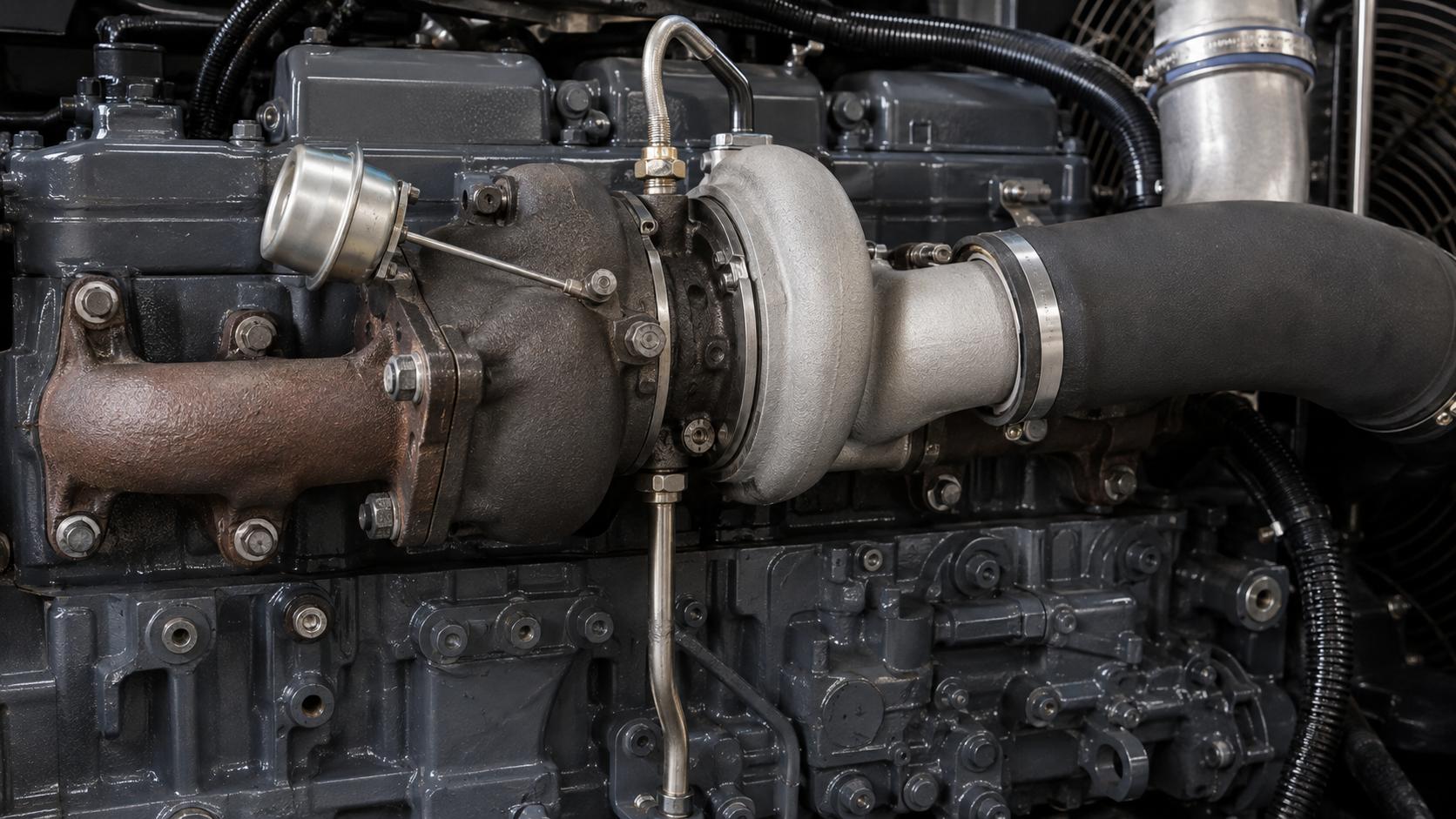
A diesel generator does not always need to stop the instant its load disappears. After a sustained run, a short, controlled cooldown can let engine temperatures stabilize while oil continues to circulate through the turbocharger and other hot components. The correct sequence matters even more at remote sites, where an inverter, automatic transfer switch, or supervisory controller may issue the stop command without an operator present.
A generator cooldown delay is not a universal fixed number. The engine manufacturer’s current operation and maintenance manual, the generator controller configuration, the electrical switching design, the recent load, and the site conditions must all agree. This guide explains what the delay does, when it can help, and what to verify before changing a setting.
What a generator cooldown delay does
During a normal automatic stop, the system should remove the electrical load before it stops the engine. The engine then runs with no load, or at a manufacturer-approved low-load condition, for the programmed cooldown period. When the timer expires, the controller shuts off fuel and completes its stop sequence.
This delay serves a different purpose from engine warmup, a restart delay, or a fuel-solenoid timer. Warmup gives the engine time to establish stable operation before accepting load. A restart delay helps prevent rapid cycling. A fuel-solenoid timer controls a specific output during starting or stopping. Calling every timer a cooldown setting can lead to incorrect programming.
The load must come off first. If a battery charger, inverter, transfer switch, or contactor continues to draw significant power throughout the countdown, the engine is still working rather than cooling under a reduced thermal load.
Why turbocharged diesel engines may benefit from cooldown
A turbocharger can remain hot and continue spinning after the engine has carried a substantial load. Engine oil lubricates its bearings and helps carry heat away. When the engine stops, oil circulation stops too. An abrupt hot shutdown can expose the oil and bearing system to unnecessary thermal stress, especially after high-load operation.
Perkins publishes general summer operating advice that recommends idling a diesel engine for 5 to 10 minutes before shutdown and explains the importance of continued oil flow through turbocharger bearings. That guidance provides useful context, but it is not a universal timer setting for every generator. Always follow the operating manual for the exact engine model, emissions configuration, and duty. See Perkins’ diesel operating guidance and use the Perkins manual lookup for model-specific instructions.
Cooldown also does not correct restricted airflow, low oil, the wrong lubricant, a damaged cooling system, excessive exhaust backpressure, or an overloaded generator. It protects the engine only when the rest of the installation and maintenance program are sound.
When cooldown deserves extra attention
The need for an orderly unloaded run becomes more important when the engine has just operated under conditions that retain more heat. Examples include:
- Sustained operation near the engine or generator’s permitted load
- High ambient temperature or restricted enclosure airflow
- High-altitude operation with an applicable power derate
- Remote prime-power service with long run periods
- Battery charging that ends immediately after a high charger demand
- Repeated automatic starts and stops within a short period
- Engine-specific aftertreatment or electronic control requirements
A longer timer is not automatically better. Excessive no-load operation consumes fuel and adds operating hours without producing useful energy. Engines with different turbocharger, cooling, emissions, and control systems can require different procedures. A lightly loaded engine that has already run unloaded may not need the same delay as an engine that has just completed a demanding cycle.
How generator controllers manage the sequence
Controllers such as the DynaGen TG350 and TG410 support programmable engine logic for automated generator systems. Depending on the model and configuration, that logic can coordinate load removal, cooldown timing, optional idle control, and the final shutdown output. Aurora uses controller capabilities like these in generator and hybrid-power applications, including products such as the 40 kW Perkins diesel generator and selected 48 volt DC generator configurations.
Controller capability does not guarantee that every installation uses the same sequence. The manual stop button may initiate cooldown, stop immediately, or require another action, depending on the programmed mode. An external two-wire input may also behave differently from a local stop command. Review the controller manual and the saved configuration before making a change.
Do not add a delay to an emergency stop or override a critical protective shutdown. Emergency and serious fault logic may stop the engine immediately because personnel safety and equipment protection take priority over a normal cooldown. Test normal stops and emergency stops as separate functions.
Temperature sensors do not tell the whole story
Coolant temperature can help operators understand general engine conditions, but it does not directly measure turbocharger bearing temperature or exhaust component temperature. A technician should not choose an arbitrary coolant threshold and assume that it proves the turbocharger has cooled sufficiently.
Useful commissioning information can include engine coolant temperature, oil pressure, generator current, calculated load, J1939 data where supported, alarm history, and the elapsed time between load removal and engine stop. Sensor type, calibration, wiring, and controller scaling must be correct before anyone relies on those values.
Some electronically controlled engines and aftertreatment systems also require a manufacturer-defined power-down process. Do not disconnect controller or engine-control power immediately after the fuel command stops unless the engine and generator documentation specifically permits it.
Remote, off-grid, and hybrid-power systems
At an off-grid site, the inverter often starts the generator through a dry-contact signal and removes that signal when the battery target has been met. The signal should request a normal stop. The generator controller should then manage unloading and cooldown according to the approved design. Aurora’s guide to two-wire generator auto-start explains the broader start and stop relationship between an inverter and generator controller.
Battery-charging systems need special attention because charger demand can change quickly. Confirm whether the inverter or charger ramps down before opening a contactor or transfer device. Also confirm that the generator controller retains control power long enough to finish its sequence. If the remote contact removes power from the entire control circuit, the programmed cooldown may never occur.
Rapid cycling can create another problem. If battery voltage or state-of-charge thresholds sit too close together, the generator may stop and restart repeatedly. Appropriate start and stop thresholds, minimum run time, restart delay, and cooldown must work as one coordinated strategy. Each value remains system-specific.
Commissioning checklist for a normal shutdown
- Identify the exact engine, controller, alternator, switching device, inverter, and charger models.
- Confirm the engine manufacturer’s current shutdown guidance and any aftertreatment requirements.
- Back up the controller configuration before changing timers or input behavior.
- Simulate a normal stop and verify that the load disconnects before the cooldown timer begins.
- Measure the actual unloaded run time and confirm the engine stops cleanly when the timer expires.
- Test local manual stop behavior and remote two-wire stop behavior separately.
- Test the emergency stop and critical protective shutdowns under an approved safety procedure.
- Confirm alarms, event logging, remote notifications, and restart-delay behavior.
- Record the final settings and the manual references used to approve them.
Signs that the shutdown logic needs review
A site review is worthwhile if the engine stops while it still carries load, the controller loses power as soon as the remote signal opens, the unit repeatedly stops and restarts, or the transfer device remains connected throughout the cooldown timer. Unusual turbocharger noise, oil leakage, recurring high-temperature alarms, or changing oil condition also require qualified diagnosis rather than a timer adjustment alone.
Event logs can help separate a normal stop request from a protective shutdown. If a high-temperature, low-oil-pressure, overspeed, or emergency-stop event caused the shutdown, find and correct the cause. Do not mask the fault by forcing the controller to continue running.
Plan the stop sequence as carefully as the start
A reliable automatic generator system needs more than a start signal. It needs a coordinated method to remove load, stabilize the engine, stop safely, preserve control power where required, and prevent immediate recycling. The right generator cooldown delay comes from the engine manual and the complete system design, not from a universal rule.
Aurora Generators can help review generator controller logic, two-wire auto-start integration, and remote or hybrid-power operating requirements. Contact Aurora Generators with the engine model, controller model, load profile, and system diagram so our team can help identify the documentation and checks your application needs.
Share this:
- Print (Opens in new window) Print
- Email a link to a friend (Opens in new window) Email
- Share on Facebook (Opens in new window) Facebook
- Share on LinkedIn (Opens in new window) LinkedIn
- Share on Reddit (Opens in new window) Reddit
- Share on Pinterest (Opens in new window) Pinterest
- Share on Threads (Opens in new window) Threads
- Share on X (Opens in new window) X
- Share on Bluesky (Opens in new window) Bluesky