
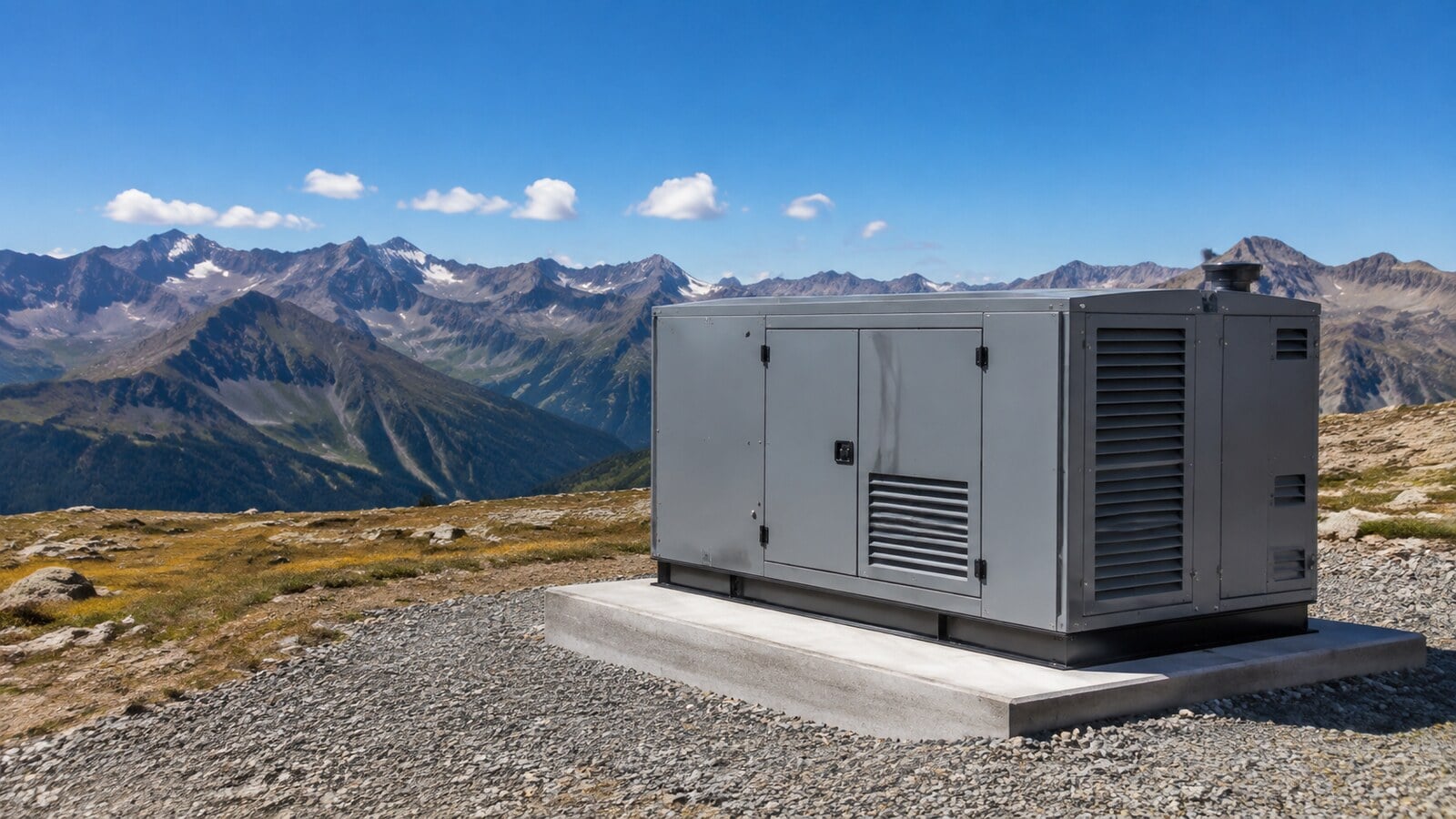
A generator nameplate doesn’t guarantee the same usable output at every site. Altitude, ambient temperature, airflow, enclosure design, and the selected duty rating can all affect the power a generator set can reliably deliver. Generator derating accounts for those conditions before you connect the load.
This matters in mountain communities, mines, farms, telecom sites, remote cabins, and hot mechanical yards. It also matters when a generator supports an inverter-charger or another load that can change quickly. A set that looks large enough on paper may have less capacity on site than its catalogue rating suggests.
What generator derating means
Derating reduces the permitted output of an engine, alternator, or complete generator set when operating conditions fall outside the reference conditions used for its published rating. The manufacturer provides the applicable reference conditions and correction factors in the product data for the exact configuration.
Start by confirming whether the quoted power is standby, prime, or continuous. These ratings describe different operating patterns and limits. Aurora’s guide to generator set ratings explains why a larger number on a specification sheet doesn’t automatically mean the set can carry that output continuously.
A complete generator set has several limits. The engine must produce enough mechanical power. The alternator must carry the electrical current without exceeding its thermal limits. The radiator, fan, enclosure, and ventilation path must reject heat. The controller and protective settings must also match the application. The lowest applicable limit governs the site rating.
Why altitude can reduce generator output
Air density decreases as elevation increases. Each intake stroke therefore contains less oxygen unless the air system can compensate. A turbocharger can reduce the effect within its designed operating range, but it does not make every turbocharged engine immune to altitude. Turbocharger speed, charge-air temperature, exhaust temperature, emissions calibration, and engine model all affect the approved output.
Thinner air can also reduce cooling performance. The radiator fan moves air by volume, but lower-density air carries less mass through the cooling package. The alternator may require its own altitude correction because reduced air density changes heat transfer inside the machine.
Do not apply a generic percentage per 1,000 feet or 300 metres to every generator. Some engines maintain full rated power to a specified altitude and then follow a model-specific curve. Others begin to derate earlier. The alternator can have a different threshold and correction factor. Use the current engine, alternator, and generator-set documentation for the exact model and rating.
Why high ambient temperature matters
A generator rejects substantial heat through the cooling system, exhaust, engine surfaces, and alternator. As the incoming air temperature rises, the system has less temperature difference to move that heat away. High intake temperature can also reduce air density and engine power.
The temperature that matters may not be the one in the weather report. In an enclosed set, the radiator and alternator can receive air that has already heated up inside the enclosure. Restricted louvres, dirty screens, recirculated discharge air, nearby walls, and wind conditions can raise the effective inlet temperature or reduce airflow.
Manufacturer ambient capability normally applies to a defined generator configuration. A different radiator, fan, canopy, exhaust arrangement, or room ventilation system can change that capability. Caterpillar’s technical discussion of enclosed generator ambient capability describes how enclosure restriction and heated internal air can affect cooling performance. Perkins also notes that environmental conditions can cause power losses and that altitude capability varies with engine design in its discussion of standby power engines.
Derate the complete generator set, not just the engine
It is easy to find an engine derating factor and stop there. That approach can miss the alternator or cooling-system limit. Review each part of the installed package:
- Engine: Confirm the rating type, altitude limit, ambient limit, fuel specification, intake restriction, exhaust backpressure, and emissions configuration.
- Alternator: Confirm the kVA rating, power factor, winding temperature rise, altitude and ambient corrections, phase arrangement, and harmonic-load limits.
- Cooling system: Verify radiator ambient capability, fan performance, coolant specification, enclosure restriction, and the path for both intake and discharge air.
- Electrical load: Account for motor starting, transformer inrush, rectifier or inverter input characteristics, phase balance, and load steps.
- Installation: Consider dust, snow, humidity, salt, ventilation, exhaust routing, service access, and the possibility of hot discharge air returning to the inlet.
Apply correction factors only as the manufacturer specifies. Do not automatically multiply an engine factor by an alternator factor. In many selections, you compare the corrected engine and alternator capacities and use the lower allowable output. Product-specific selection software or written application approval should settle any uncertainty.
A practical derating example
Consider a generator with a published rating of 40 kW. For the proposed site, assume the manufacturer documents an engine capability factor of 0.94 and an alternator capability factor of 0.96. Assume the supplied cooling package has also been verified for the site’s maximum inlet temperature and installation arrangement.
The engine limit would be 40 kW multiplied by 0.94, or 37.6 kW. The alternator limit would be 40 kW multiplied by 0.96, or 38.4 kW. If the manufacturer instructs the designer to compare the two limits, the lower value, 37.6 kW, becomes the maximum site-rated output. This example is illustrative only. It does not provide correction factors for any specific Aurora, Perkins, or alternator model.
Aurora often suggests selecting a generator so that its typical sustained load is around 70 percent of the valid site-rated power. Many diesel engines operate efficiently in this range, and the remaining capacity provides useful headroom for reasonable load changes. In this example, 70 percent of 37.6 kW is about 26.3 kW. Treat that figure as a planning target, not a universal operating rule. The approved rating, duty cycle, minimum-load guidance, transient requirements, and manufacturer instructions still control the final selection.
Do not calculate the 70 percent target from the original 40 kW nameplate after site derating applies. Doing so would overstate the intended operating margin. Also confirm kVA and power factor, because the alternator can reach its current limit before the engine reaches its kW limit.
Battery charging and hybrid systems need extra headroom
An inverter-charger can ask for substantial AC input while other loads remain online. Charger efficiency, power factor, AC input limits, and the inverter’s load-support behaviour all influence generator loading. A sudden charging command can also create a larger step than the engine accepts cleanly at a difficult site.
Configure the charger’s maximum AC input or charge current based on the derated site capacity, not solely the generator nameplate. Preserve capacity for concurrent loads and load steps. Aurora’s article on generator overload while charging batteries explains how inverter-charger settings and power factor can affect the result.
For a hybrid system, generator run strategy also matters. A properly sized set can charge batteries at a productive load and then shut down while stored energy supplies smaller loads. That operating pattern can reduce inefficient light-load running, but the inverter, battery, controls, and generator must all be compatible.
Information to collect before selecting a generator
Provide realistic site and load information before requesting a final generator selection:
- Site elevation above sea level
- Highest expected temperature at the generator air inlet
- Lowest expected starting temperature
- Indoor, outdoor, open-set, or enclosed installation
- Ventilation restrictions and risk of hot-air recirculation
- Standby, prime, or continuous operating profile
- Steady kW, kVA, power factor, phase, voltage, and frequency
- Largest motor, charger, transformer, or other step load
- Fuel type and any manufacturer-approved fuel limitations
- Expected expansion and the desired operating margin
For example, Aurora’s 40 kW Perkins diesel generator page provides a starting point for product discussion. The final usable capacity still depends on the selected voltage, rating, options, installation, and verified site conditions.
Common generator derating mistakes
- Using sea-level nameplate power for a high-elevation installation
- Using the outdoor weather temperature instead of the generator’s actual inlet-air temperature
- Checking the engine but not the alternator or cooling package
- Applying a generic derating percentage to every engine family
- Ignoring power factor, motor starting, charger limits, or unbalanced phase loads
- Adding an enclosure or changing ventilation without rechecking ambient capability
- Treating standby power as an unrestricted continuous-duty rating
Plan from the site rating
Generator derating isn’t a penalty added after purchase. It is a normal engineering step that turns a catalogue rating into a realistic site capability. Confirm the engine, alternator, cooling package, electrical load, and duty rating as a package. Then apply the desired operating margin to that verified capacity.
If you are planning backup, prime, remote, or hybrid power, contact Aurora Generators with the site elevation, temperature range, load list, voltage, phase, and expected operating profile. We can help identify the product data and application questions that need answers before you choose a generator.
Share this:
- Print (Opens in new window) Print
- Email a link to a friend (Opens in new window) Email
- Share on Facebook (Opens in new window) Facebook
- Share on LinkedIn (Opens in new window) LinkedIn
- Share on Reddit (Opens in new window) Reddit
- Share on Pinterest (Opens in new window) Pinterest
- Share on Threads (Opens in new window) Threads
- Share on X (Opens in new window) X
- Share on Bluesky (Opens in new window) Bluesky