
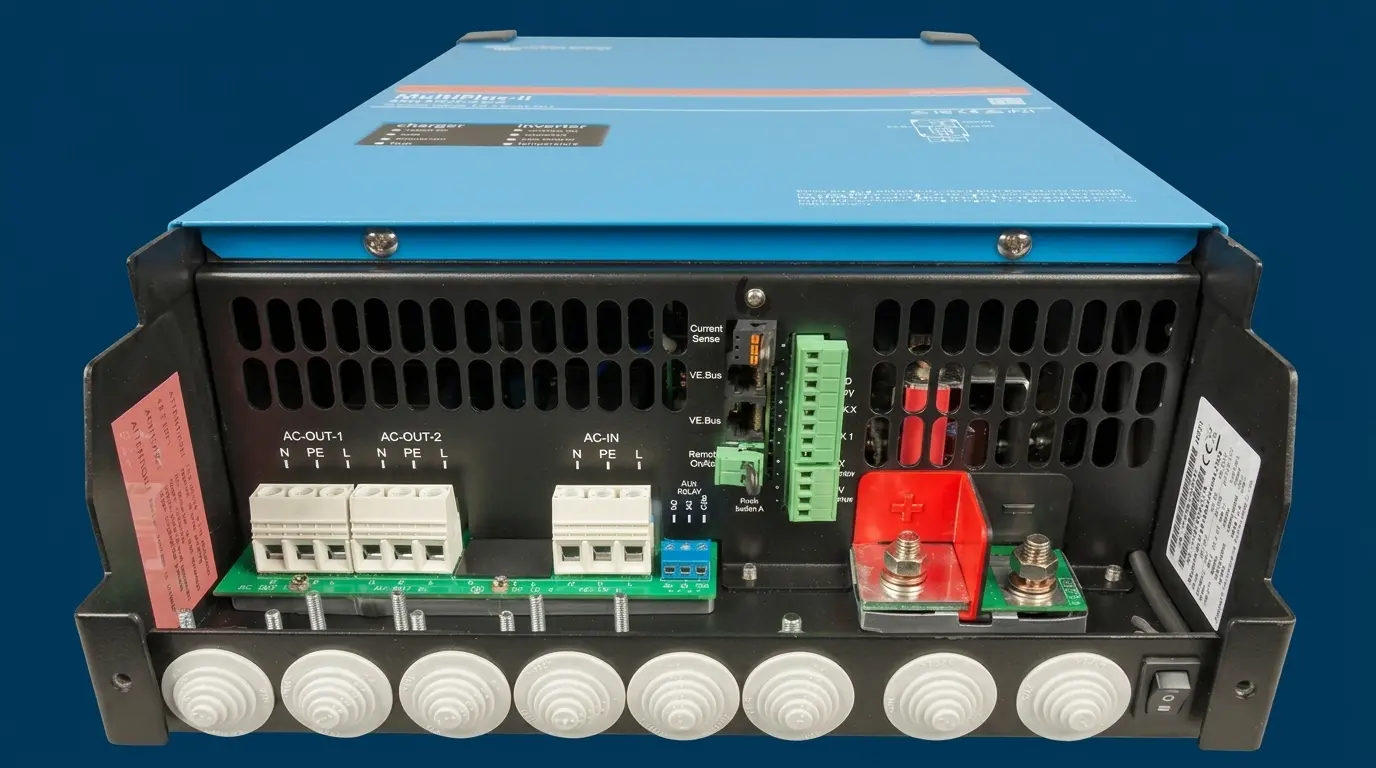
Choosing between a 120 V generator and a 120/240 V split-phase generator starts with the AC input your off-grid inverter-charger can actually use. The generator’s total kW rating matters, but it is not the whole story. Voltage, per-leg current, inverter input configuration, and any loads running while the batteries charge determine the usable charging power.
A generator can look large enough on paper and still trip a breaker or overload one leg if a 120 V inverter-charger is supplied from only one side of a 120/240 V generator. This guide keeps the decision focused on matching generator output to an off-grid inverter system.
Quick Answer: Which Generator Voltage Fits Your Inverter?
- Choose a dedicated 120 V generator configuration when the inverter-charger accepts only 120 V, the site has no meaningful 240 V loads, and the generator is specifically approved to deliver its full output at 120 V.
- Choose a 120/240 V split-phase generator when the property needs both 120 V and 240 V loads, the inverter system accepts 240 V or split-phase input, or two coordinated 120 V inverter-chargers can share the charging load across both legs.
Do not select voltage from generator size alone. Start with the inverter-charger’s nameplate and manual, then calculate the charging load in kW and kVA.
Start With the Inverter-Charger
Before comparing generator models, confirm the exact inverter-charger requirements:
- Accepted AC input voltage and frequency
- Maximum AC input current
- Whether it accepts 120 V, 240 V, or 120/240 V split-phase input
- Maximum battery charging current and charging voltage
- Power factor and efficiency at the planned charging level
- Pass-through loads that can operate while charging
- Neutral, bonding, transfer, grounding, and generator-start requirements
Inverter-chargers with similar names may have different AC input arrangements. Some are 120 V only, some accept 240 V, and some split-phase systems use two coordinated units—one connected to each 120 V leg. Verify the exact model and regional version before designing the generator connection.
What 120 V and 120/240 V Split-Phase Output Mean
A 120 V generator provides one line conductor and a neutral. Its approved breaker, alternator, conductors, and continuous rating determine how much 120 V power it can deliver.
A North American 120/240 V split-phase generator provides two 120 V legs that are 180 electrical degrees apart. Each leg measures 120 V to neutral; the voltage between the two legs is 240 V.
For example, a typical 10 kW, 120/240 V single-phase generator is rated at about 41.7 A at 240 V. Each 120 V leg can normally supply about 41.7 A, or roughly 5 kVA per leg. A single large 120 V inverter-charger connected to one leg cannot automatically use the generator’s full 10 kW rating.
That is the central difference for off-grid battery charging: the unused capacity on the opposite leg does not necessarily become available to a charger running on the loaded leg.
When a 120 V Generator Makes Sense
A dedicated 120 V configuration can be a practical choice when the off-grid inverter-charger is 120 V only and the site does not have 240 V equipment. It is especially useful when one large 120 V charger needs more current than one leg of a split-phase generator can supply.
Some reconnectable alternators can place windings in parallel for an approved, dedicated 120 V output. This may make more alternator capacity available to a single 120 V load, but it is not a field modification to be made from a generic diagram. The alternator manufacturer must approve the configuration, and breakers, conductors, terminals, controller sensing, and protection must all be rated for the higher current.
The tradeoff is current. Delivering the same power at 120 V requires twice the current required at 240 V. That can mean larger conductors, larger overcurrent protection, more voltage-drop sensitivity, and a more demanding installation.
When a 120/240 V Split-Phase Generator Is Better
A 120/240 V split-phase generator is usually the stronger all-purpose choice when the property has a normal North American distribution panel, 240 V pumps or tools, or an inverter system that can use both legs.
It is a good fit when:
- The building has both 120 V and 240 V loads.
- The inverter system accepts 240 V or split-phase generator input.
- Two coordinated 120 V inverter-chargers can divide charging across both legs.
- The generator must support a home, cabin, shop, well pump, compressor, or other 240 V equipment in addition to charging.
Balance 120 V loads across the two legs as closely as practical. A severe imbalance can limit usable capacity, increase voltage deviation, and cause one winding to heat more than the other. The acceptable imbalance depends on the alternator and generator design.
Battery Amps Are Not Generator Amps
Do not compare the battery charger’s DC output current directly with the generator’s AC current rating. Convert the charging requirement to power first.
For example, assume a 48 V battery bank charges at 100 A and the charging voltage is about 56 V:
- DC charging power: 56 V × 100 A = 5.6 kW
- At 90% charger efficiency: about 6.2 kW AC input
- At 0.95 power factor: about 6.5 kVA
- Equivalent AC current: roughly 54 A at 120 V, or 27 A at 240 V
These are examples, not universal specifications. Battery voltage, charging current, efficiency, and power factor vary by battery chemistry, state of charge, temperature, programmed limits, and charger model.
In this example, a 54 A 120 V charging load would exceed one leg of a typical 10 kW split-phase generator—even though the charger’s real power is below the generator’s total nameplate rating. A 240 V charger, or two properly coordinated 120 V chargers balanced across both legs, can use the available output more effectively.
Size for the Applicable Continuous Load, Not the Nameplate Maximum
For sustained battery charging, Aurora commonly uses about 70% of the applicable prime or continuous generator rating as a planning target. This leaves room for charger ramp-up, other site loads, temperature or altitude derating, and normal operating variation.
For example, if the charger needs 6.2 kW and other loads add 1.0 kW, the running load is 7.2 kW before accounting for power factor and transients. Dividing 7.2 kW by 0.70 produces a preliminary generator size of about 10.3 kW. The final selection may need to be larger after checking kVA, per-leg current, motor starting, derating, and the generator’s published rating.
For related troubleshooting, see Generator Overload When Charging Batteries.
Generator Selection Checklist for Off-Grid Inverters
Gather these details before choosing between a 120 V and 120/240 V generator:
- Exact inverter-charger make and model
- Required AC input: 120 V, 240 V, or split-phase
- Maximum programmed AC input current
- Battery chemistry, nominal voltage, and allowed charge current
- Loads that will operate during charging
- Any 240 V loads and their starting requirements
- Expected generator run time and duty classification
- Site altitude and expected ambient temperature
- Required auto-start and transfer method
The practical choice is simple: use a 120 V generator when the inverter and site are truly 120 V and the approved generator configuration can supply the needed current. Use a 120/240 V split-phase generator when the inverter system or property needs both legs, 240 V loads, or a balanced split-phase charging arrangement.
A qualified electrical professional should complete the final design, overcurrent protection, grounding, transfer equipment, and installation for the equipment and local code requirements. Aurora Generators can review your inverter model numbers and expected loads to help identify a suitable generator configuration before ordering.
Share this:
- Print (Opens in new window) Print
- Email a link to a friend (Opens in new window) Email
- Share on Facebook (Opens in new window) Facebook
- Share on LinkedIn (Opens in new window) LinkedIn
- Share on Reddit (Opens in new window) Reddit
- Share on Pinterest (Opens in new window) Pinterest
- Share on Threads (Opens in new window) Threads
- Share on X (Opens in new window) X
- Share on Bluesky (Opens in new window) Bluesky