
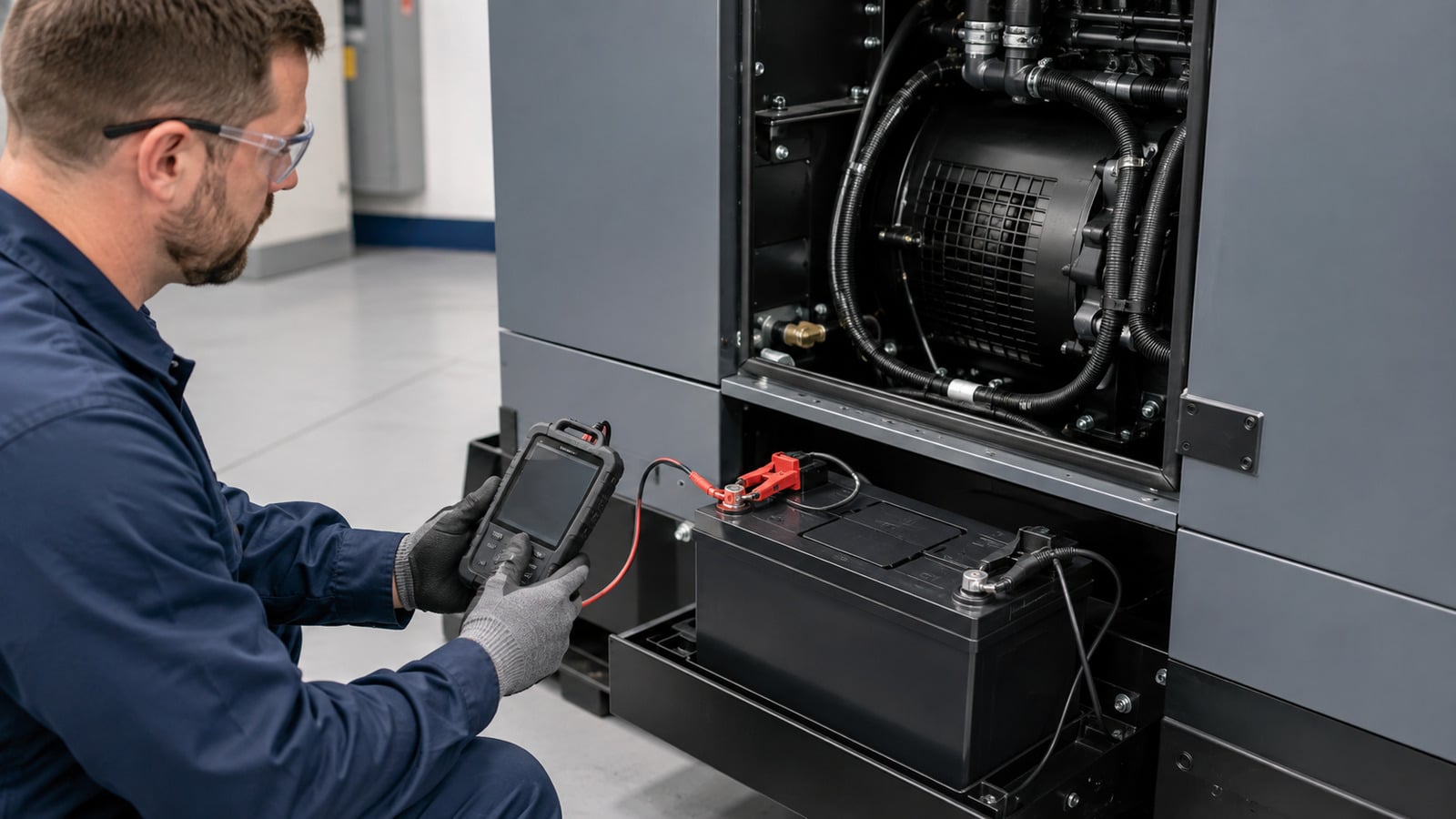
A generator starting battery can show about 12 volts at rest and still fail when the starter motor demands high current. A resting voltage reading helps estimate the state of charge, but it does not prove that the battery can deliver the required cranking power.
A complete generator starting battery test looks at the battery, cables, connections, starter circuit, charging source, ambient conditions, and controller records. Testing the system under controlled conditions prevents unnecessary battery or starter replacement and provides better evidence before the next outage.
Why Resting Voltage Can Be Misleading
A digital multimeter draws very little current from a battery. A weak battery may therefore display a plausible open-circuit voltage even though internal resistance, plate deterioration, sulphation, low electrolyte, or reduced capacity prevents it from supporting a starter motor.
Recent charging can also leave a temporary surface charge. Conversely, a healthy battery may show a lower reading after controller operation, glow-plug use, or repeated start attempts. Let the battery stabilize and follow the manufacturer’s procedure before interpreting an open-circuit measurement.
A 12-volt label indicates the nominal system voltage. It is not a universal pass value. Battery chemistry, temperature, state of charge, battery age, engine size, starter design, and the controller’s undervoltage settings all affect the result.
Cranking Demand Is the Real Test
A diesel starter motor requires substantial current to turn the engine fast enough for compression ignition. Cold oil increases mechanical resistance. Glow plugs or an intake heater can consume energy before cranking begins. Those loads expose weaknesses that a resting voltage check cannot reveal.
A suitable battery load test or conductance test estimates available starting capability. The technician should compare the result with the battery rating and the engine manufacturer’s battery requirements. A tester’s automatic pass/fail message is useful only when the technician enters the correct battery type, rating, temperature, and test method.
During a controlled start attempt, observe battery voltage, cranking speed, controller behaviour, and the attempt duration. Use the engine, starter, battery, and controller specifications to interpret the measurements. Do not apply one universal minimum cranking voltage to every generator.
Controller Logs Can Preserve Important Evidence
A generator controller may record low battery voltage, failed crank attempts, low cranking speed, or a start failure. The event history can show whether the voltage collapsed immediately, declined over several attempts, or remained reasonable while the engine failed to fire.
The controller measures voltage at its own connection, not necessarily at the battery posts. A poor ground, undersized control conductor, weak connection, or voltage drop elsewhere can cause the controller to read a different value. Confirm measurements at the correct points before concluding that the battery caused the alarm.
Measure Voltage Drop While Current Flows
A cable can look clean and still have excessive resistance inside a crimp, terminal, disconnect, or ground connection. Resistance becomes most visible while the starter is drawing current. An unloaded continuity test may miss the fault.
Fluke recommends voltage-drop testing across the positive and ground sides of a starter circuit during cranking. The method helps separate battery weakness from resistance in cables and connections. The allowable drop depends on the equipment and test points, so use the applicable service data.
Slow cranking can result from a discharged battery, a low-capacity battery, loose or corroded terminals, damaged cables, poor engine grounding, a starter fault, unsuitable oil viscosity, or mechanical resistance. Measure before replacing parts.
Check the Battery Maintainer and Running Charge
A standby generator controller continues to consume power while it waits in Auto mode. Without a functioning maintainer, that small load can discharge the starting battery over time. A charger can also display a normal status while a blown fuse, disconnected conductor, poor terminal, or incorrect setting prevents the battery from receiving the intended charge.
Verify charger input power, battery-terminal voltage, charger status, configuration, and wiring against the charger and battery instructions. After the generator runs, confirm that its engine-mounted charging system operates within the manufacturer’s specifications. Do not assume that one charging voltage suits every battery chemistry or temperature.
Aurora offers a 12-volt onboard battery maintainer for suitable applications. Confirm capacity, chemistry, temperature compensation, installation method, and generator compatibility before selecting any charger.
A Five-Part Generator Starting Battery Test

- Inspect: Check the battery case, tray, hold-down, terminals, cables, protective covers, electrolyte where serviceable, and signs of heat or corrosion.
- Establish charge condition: Measure stabilized resting voltage and confirm that the maintainer has operated as intended.
- Test battery capability: Use a suitable load or conductance test and compare the result with the battery rating and engine requirements.
- Observe the real start: Record cranking voltage, speed, controller messages, and start duration under controlled conditions.
- Test the circuit and recovery: Check positive and return-path voltage drop during cranking, then verify charging after the engine starts.
The sequence matters. Replacing the battery before checking cable resistance or charger operation can hide the original fault until the new battery also becomes discharged.
Special Considerations for 24 Volt Starting Systems
Many larger generators use two 12-volt batteries in series for a 24-volt starting system. Follow the battery manufacturer’s instructions to test each battery individually, then evaluate the pair as a system. Batteries with different ages, capacities, states of charge, or internal condition can become unbalanced.
Confirm the full series path, interconnecting cable, polarity, charger configuration, controller supply, and starter rating. Never assume that a correct total voltage proves that both batteries contribute equally during cranking.
Safety Before Testing
Automatic starting creates a serious hazard. Place the generator in the required safe service state, isolate remote-start commands, and follow the generator manufacturer’s lockout and battery-disconnection instructions.
Batteries can produce explosive gas and very high fault current. Wear appropriate eye protection, remove jewellery, use insulated tools, keep sparks and flames away, and never place a tool across battery terminals. A qualified technician should perform high-current testing and starter-circuit diagnosis.
How This Complements Aurora's Existing Battery Advice
Aurora’s guide to keeping a generator battery charged explains self-discharge, maintainers, and cold-temperature effects. The cold-weather starting guide covers glow plugs, oil-pan heat, and the extra demand a battery faces in winter. This article adds a diagnostic process for situations where voltage alone does not explain a starting problem.
Plan the Test Before the Next Outage
Do not rely on a green charger light or a single resting-voltage measurement. Record the battery age and rating, test its available starting capability, observe a controlled crank cycle, check cable voltage drop, and verify charging performance using the applicable specifications.
Aurora Generators can help customers review starting-battery requirements, charger selection, controller records, and generator-specific service information. Contact Aurora with the generator model, battery rating, controller messages, ambient temperature, and test results so the next step addresses the actual cause.
Share this:
- Print (Opens in new window) Print
- Email a link to a friend (Opens in new window) Email
- Share on Facebook (Opens in new window) Facebook
- Share on LinkedIn (Opens in new window) LinkedIn
- Share on Reddit (Opens in new window) Reddit
- Share on Pinterest (Opens in new window) Pinterest
- Share on Threads (Opens in new window) Threads
- Share on X (Opens in new window) X
- Share on Bluesky (Opens in new window) Bluesky