
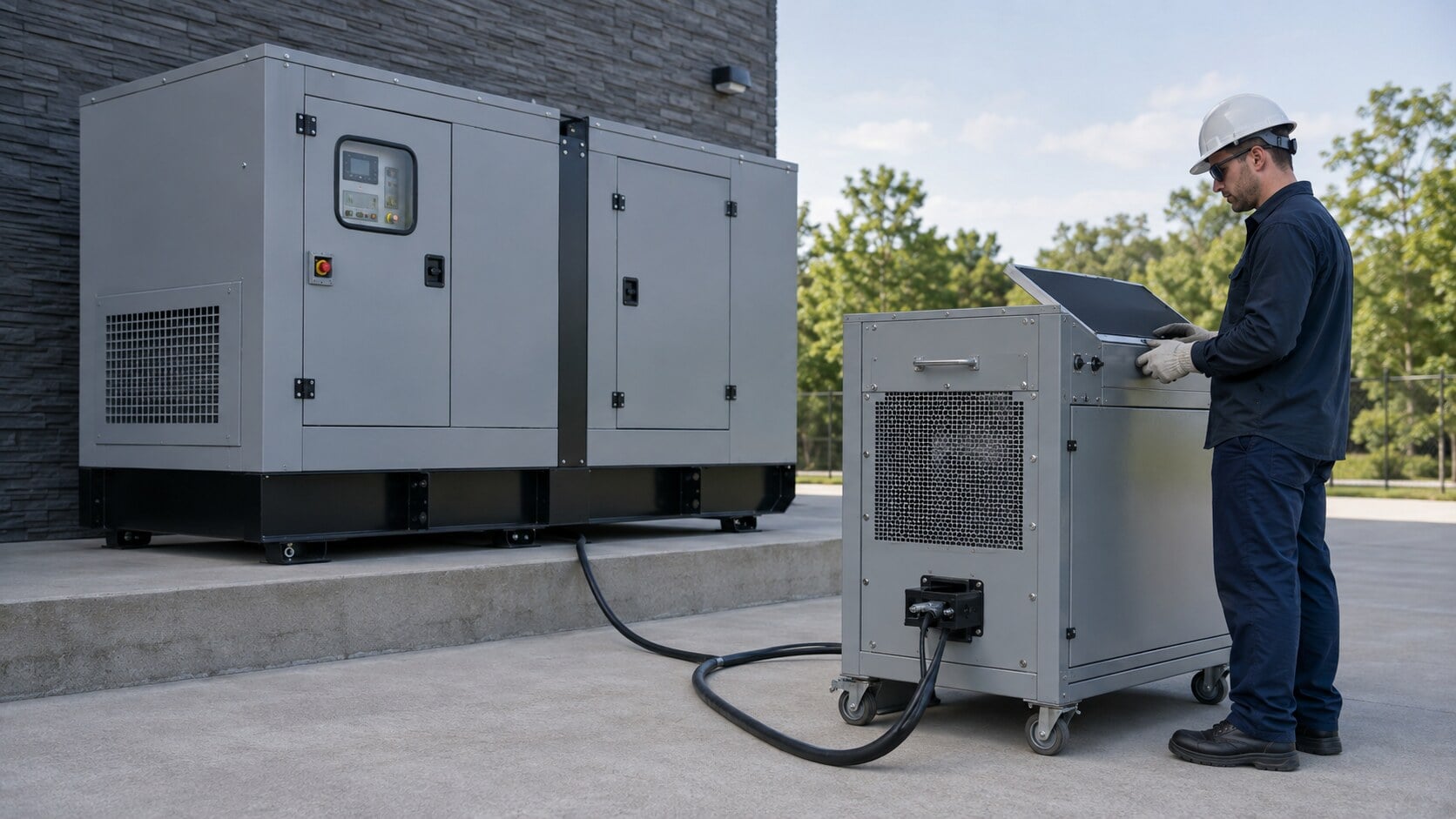
Generator load-bank testing applies a controlled electrical load so you can see how a generator performs beyond a simple no-load exercise. It can provide useful evidence during commissioning, periodic readiness checks, troubleshooting, and post-repair verification. It is not a universal maintenance cure, and the correct load, duration, test sequence, and acceptance limits depend on the generator set, duty rating, manufacturer instructions, site design, and any rules that apply to the facility.
A start-and-run test confirms that the engine starts and the alternator produces voltage. It does not prove that the cooling system can reject heat, the engine can carry its rated site load, the governor and voltage regulator respond correctly, or the fuel system can support a sustained run. A properly planned load-bank test examines those conditions under a known load.
What is a generator load bank?
A load bank converts generator output into a controlled test load. A resistive unit primarily tests real power in kilowatts at a power factor close to 1.0. A reactive unit adds inductive loading so the test can also examine kilovolt-amperes, current, and power factor conditions that may better represent motors, transformers, and other facility loads.
Resistive testing is common, but it does not reproduce every site load. Nonlinear equipment such as inverter-chargers, variable-frequency drives, rectifiers, and uninterruptible power supplies can draw current differently from a resistive bank. If the concern involves harmonics, poor power factor, motor starting, or a specific inverter, the test plan must address that equipment and the required measurements rather than assuming a resistive test proves compatibility.
When load-bank testing provides the most value
Commissioning a new or modified generator system
A commissioning test establishes a baseline before relying on the generator during an outage. The test can confirm stable voltage and frequency, cooling-system performance, oil pressure, fuel delivery, alarms, shutdowns, leaks, and the ability to carry selected load steps. It also lets the commissioning team compare actual results with the generator manufacturer’s approved limits.
Load-bank testing does not replace a complete system test. If the bank connects at the generator, it may not exercise the automatic transfer switch, feeder, distribution equipment, control logic, or actual emergency loads. Commissioning may therefore require both a controlled load-bank test and a separate facility transfer test. The engineer or qualified commissioning provider should define what each test must prove.
Periodic testing when the building cannot provide enough load
Some standby generators serve a facility whose normal test load is small compared with the generator rating. A routine exercise may transfer only lighting, controls, and a few small loads. The engine starts, but coolant and exhaust temperatures may remain too low to demonstrate performance under a meaningful load.
A load bank can supplement the available building load and produce repeatable test conditions. The appropriate interval is not the same for every generator. Follow the current engine and generator manuals, the approved maintenance program, operating history, insurer requirements, and the rules adopted by the authority having jurisdiction. Standards such as NFPA 110 and CSA C282 may apply to specific emergency-power systems, but their requirements depend on the adopted edition, application, and jurisdiction. Do not apply a generic online schedule to every site.
Generators that spend too much time lightly loaded
Extended operation at very low load can prevent a diesel engine from reaching the combustion and exhaust temperatures intended for its application. This can contribute to exhaust slobber, often called wet stacking, as well as carbon deposits and oil dilution in some conditions. Caterpillar’s generator underloading guidance explains that acceptable operating ranges and low-load limits depend on the generator rating and application.
A controlled loaded run may be part of the response, but it should not replace proper generator sizing or an appropriate operating strategy. Persistent underloading calls for a review of the real load profile, engine manufacturer limits, exercise method, and whether load management, a smaller generator, or a different system arrangement would provide better long-term operation. Aurora’s wet-stacking guide explains the related causes and warning signs.
After major repairs or performance concerns
A load-bank test can help verify work involving the engine, fuel system, cooling system, turbocharger, governor, alternator, voltage regulator, breaker, or major control components. It can also support troubleshooting when a generator overheats, smokes, loses frequency, shows unstable voltage, trips under load, or cannot accept a normal load step.
Testing should follow diagnosis, not replace it. If the generator has low oil pressure, a coolant leak, contaminated fuel, damaged wiring, abnormal noise, an unresolved alarm, or evidence of mechanical failure, correct or assess that condition before adding load. A load bank can expose a weak system quickly, which is useful only when qualified personnel, safe limits, and a shutdown plan are in place.
What evidence does a good test provide?
A useful test records conditions before, during, and after each load step. The exact list depends on the generator, but a qualified technician may document:
- Ambient temperature, site elevation, and generator configuration
- Voltage, frequency, current, kilowatts, kilovolt-amperes, and power factor when applicable
- Voltage and frequency response during controlled load changes
- Engine speed, oil pressure, coolant temperature, and other available engine data
- Radiator airflow, fan operation, enclosure temperature, and signs of hot-air recirculation
- Fuel level, fuel pressure or restriction where specified, and leaks
- Exhaust condition, unusual smoke, exhaust leaks, and abnormal vibration or noise
- Controller alarms, shutdown functions, event logs, and return-to-ready status
Stable operation at one steady load does not prove every transient requirement. A generator may carry a gradual resistive load but respond poorly when a large motor starts or an inverter-charger changes demand rapidly. Conversely, a short facility load step may show transient response but not reveal a marginal radiator, fuel restriction, or overheating problem that develops during a sustained run.
Manufacturer test procedures define the relevant limits. Published standby, prime, and continuous ratings are not interchangeable, and site derating for altitude, temperature, fuel, enclosure, or emissions equipment can reduce the permitted test load. The load-bank provider should use the approved site rating, not simply the largest number found on a brochure or engine data sheet.
A practical pre-test checklist
- Identify the generator model, serial number, voltage, phase, frequency, rating, engine, alternator, controller, breaker, and site derating.
- Review the current operation and maintenance manuals, service records, previous test reports, open alarms, and known defects.
- Define the purpose of the test and the acceptance criteria. Commissioning, periodic readiness, troubleshooting, and post-repair verification do not use the same plan.
- Confirm whether a resistive bank is sufficient or whether reactive loading, facility loads, load steps, or power-quality measurements are required.
- Verify that the load bank, cables, connectors, switching method, grounding, overcurrent protection, and connection point are correctly rated and installed by qualified personnel.
- Inspect oil, coolant, fuel, air intake, exhaust, batteries, belts, hoses, radiator, enclosure airflow, and visible leaks before starting.
- Establish ventilation, exhaust, noise, heat-discharge, fire-safety, barricade, communication, and emergency-shutdown controls.
- Plan incremental load steps, hold periods, readings, stopping limits, cooldown, and return-to-service checks according to the approved procedure.
- Coordinate any interruption, transfer-switch operation, critical loads, remote alarms, and monitoring notifications with the facility.
Load banks reject significant heat and may use high-current temporary connections. Keep people and combustible material clear of discharge air and equipment, and do not improvise adapters or cable arrangements. A qualified electrical and generator service provider should perform the connections and test.
How often should a generator be load-bank tested?
There is no single interval that fits every generator. A unit that regularly carries a meaningful facility load may not need the same supplemental testing as an oversized standby set that exercises at very low load. A critical healthcare, life-safety, data, water, or industrial system may also have formal testing obligations that do not apply to a residential standby generator.
Build the schedule from the generator manufacturer requirements, applicable codes and standards, facility risk, duty, actual exercise loading, event history, and maintenance results. Cummins includes load-bank testing within its power-generation service programs, while noting that the exact services depend on the application and certification requirements. This is a good example of why the test belongs within a site-specific maintenance strategy rather than a universal calendar rule.
How to interpret the result
A passing report should show what was tested, where the bank connected, the applicable generator rating, the load steps, duration, measurements, limits, and final condition. A statement that the generator “ran at full load” is not enough without the supporting data and the rating basis.
A failed result is also useful when it identifies the condition and the point at which it appeared. Overheating, voltage instability, frequency droop, smoke, fuel starvation, protective trips, or abnormal vibration should lead to diagnosis and corrective work. Do not repeatedly load the generator in the hope that a serious fault will clear itself.
After the test, inspect for leaks and loose components, review event logs, complete the manufacturer-approved cooldown and shutdown sequence, disconnect the test equipment safely, restore normal controls, and confirm that the generator has returned to automatic ready status. Record all corrective actions and schedule a verified retest where required.
Load testing should answer a specific question
Generator load-bank testing is most valuable when the test has a defined purpose. Use it to establish a commissioning baseline, supplement inadequate building load, evaluate chronic light-load operation, verify repairs, or investigate a performance concern. Do not treat it as automatic proof of the entire emergency-power system or as a cure for incorrect sizing and maintenance.
For related planning, review Aurora’s guides on exercising a generator under load and diesel generator maintenance.
Plan the test with Aurora Generators
Aurora Generators can help you identify the generator information, load profile, duty rating, and manufacturer limits needed to plan a useful test. Contact Aurora Generators with the model, serial information, site voltage, actual exercise load, service history, and reason for testing. A qualified local provider should complete the site connection and testing procedure.
Share this:
- Print (Opens in new window) Print
- Email a link to a friend (Opens in new window) Email
- Share on Facebook (Opens in new window) Facebook
- Share on LinkedIn (Opens in new window) LinkedIn
- Share on Reddit (Opens in new window) Reddit
- Share on Pinterest (Opens in new window) Pinterest
- Share on Threads (Opens in new window) Threads
- Share on X (Opens in new window) X
- Share on Bluesky (Opens in new window) Bluesky