
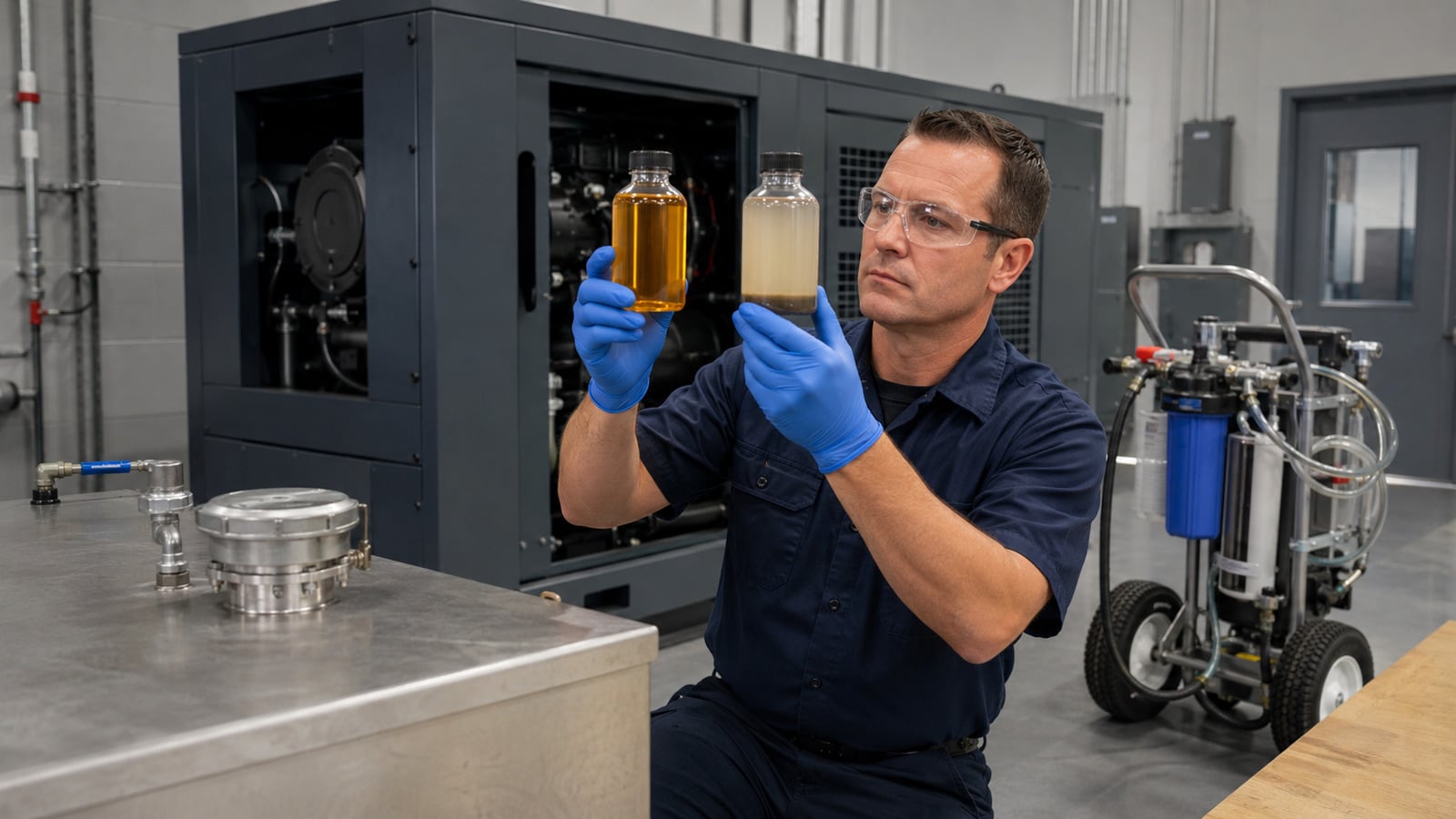
A standby generator can have a full tank and still lack dependable fuel. Stored diesel can collect water, sediment, oxidation products, and microorganisms. Those conditions can restrict filters, damage fuel-system components, cause hard starting, or reduce engine power when the generator must carry a real load.
Generator fuel polishing can help in the right situation, but it isn’t an automatic answer to every fuel concern. A sound maintenance decision starts with the tank history, a representative sample, and a clear understanding of what the process can and cannot correct.
What Is Generator Fuel Polishing?
Fuel polishing recirculates diesel from a storage tank through equipment selected to remove suspended particles and separate free water. The service may use several filtration stages and may draw from different tank levels to address contamination that ordinary engine filters cannot manage efficiently.
Polishing differs from replacing the generator’s fuel filter. The engine filter protects the fuel system from a limited amount of contamination as the engine runs. It does not clean the full tank, remove a large bottom layer of water, repair damaged fuel, or correct the source of repeated contamination.
Why Stored Diesel Develops Problems
Diesel quality depends on the fuel, storage time, tank condition, temperature, humidity, fuel turnover, and handling practices. Common contaminants include water, microorganisms, wax, hard particles, debris, and sediment.
Water can enter through condensation, damaged seals, poor transfer practices, or contaminated deliveries. Microorganisms can grow where water and fuel meet. Their byproducts may form sludge that blocks filters. Dirt and corrosion products can also settle at the tank bottom, where a generator may draw them into the fuel system during an extended run.
Modern high-pressure fuel systems can be especially sensitive to contamination. Perkins advises keeping fuel clean and free of dirt, moisture, and other contaminants because contamination can cause premature wear, hard starting, low power, and extra filter maintenance.
Start With Inspection and Representative Sampling
A clear sample taken from the top of a tank does not prove that the entire fuel inventory is clean. Water and heavy sediment often settle near the bottom. A qualified fuel service provider should choose sampling locations and methods that reflect the tank design and the concern being investigated.
Review the fuel delivery history, tank condition, vent and fill seals, water-separator findings, filter changes, alarm records, and engine symptoms. Testing may examine water, sediment, microbial activity, oxidation stability, or other properties appropriate to the fuel and engine requirements. The required tests and acceptance limits depend on the fuel specification, engine manufacturer, storage application, and service provider.
When Fuel Polishing May Make Sense
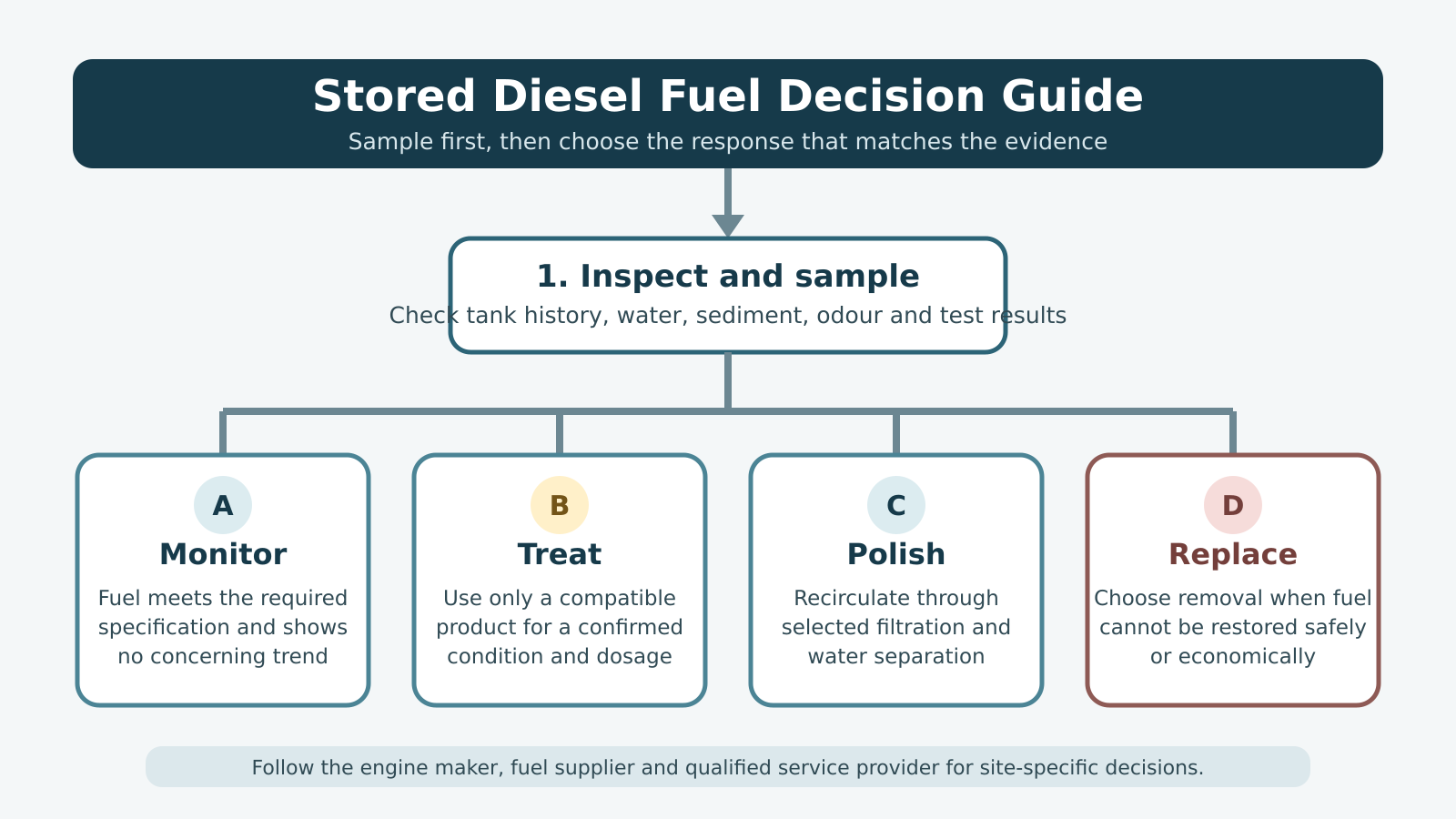
Polishing may be appropriate when sampling confirms suspended solids or separable water and the bulk fuel remains suitable for restoration. It can also support maintenance after a contamination event, repeated filter restriction, or a long storage period when a qualified provider confirms that filtration and water separation address the actual condition.
The service plan should match the tank geometry, fuel volume, contamination level, and desired cleanliness. The provider should also address the source of the contaminant. Polishing fuel without repairing a leaking fill cap, damaged vent, poor transfer hose, or water-entry problem invites the condition to return.
When an Additive Is Not Enough
An additive should solve a confirmed problem and remain compatible with the fuel, engine, tank materials, and manufacturer requirements. A stabilizer cannot remove free water or sediment. A biocide may control confirmed microbial growth, but killing organisms can leave material that filters or polishing equipment must remove. Incorrect products or dosages can create additional problems.
Do not mix treatments based only on appearance or odour. Ask the fuel supplier, engine manufacturer, or qualified fuel specialist to identify the condition and select an appropriate response. Follow all handling instructions and applicable environmental requirements.
When Tank Cleaning or Fuel Replacement Is the Better Choice
Fuel polishing cannot reverse every form of degradation. Replacement or tank cleaning may be a safer, more economical option when testing shows the fuel no longer meets the required specification, when contamination is severe, when sludge coats internal tank surfaces, or when incompatible material has entered the tank.
Tank entry, waste-fuel handling, and contaminated-water disposal require trained personnel and appropriate procedures. Generator owners should not enter a fuel tank or improvise disposal. A qualified contractor can assess the tank, remove waste, clean accessible surfaces where appropriate, and document the work.
Signs That Justify a Fuel-Quality Investigation
- Repeatedly restricted or unusually dirty fuel filters
- Water or dark sediment in the fuel-water separator
- Hard starting, unstable operation, or loss of power after other causes have been ruled out
- A stale or unusual fuel odour, haze, visible layers, or suspended material in a representative sample
- An unknown delivery history, long storage period, flood exposure, or damaged tank opening
- A generator that passes a short no-load exercise but struggles during a longer loaded run
These signs do not diagnose the fuel issue on their own. Air restrictions, mechanical faults, control issues, and other conditions can produce similar symptoms. A service provider should confirm the cause before recommending treatment.
How to Reduce the Need for Emergency Fuel Remediation
Those practices help control the paths that allow contamination to enter.
- Use diesel-compatible transfer hoses, pumps, caps, and seals.
- Inspect the tank and fuel system for leaks, damage, and water entry.
- Drain water separators and service filters according to the applicable manual.
- Track deliveries, test results, filter changes, and contamination events.
- Plan fuel turnover without compromising the reserve needed for the site’s outage strategy.
- Exercise and load-test the generator according to the generator manufacturer’s requirements and the site’s maintenance plan.
For more background, review Aurora’s guides to diesel fuel storage, fuel-water separators, and generator fuel-tank selection. Owners planning for long outages should also review the generator’s duty rating, fuel reserve, maintenance intervals, and resupply plan.
A Practical Decision Before the Next Outage
Do not wait for a blocked filter or a no-start condition to discover that stored fuel needs attention. If the tank history is unclear, the generator has shown fuel-related symptoms, or the site depends on a large reserve, arrange representative sampling and review the results with a qualified fuel-service provider.
Aurora Generators can help customers review the generator, tank arrangement, filtration, duty requirements, and maintenance history before they choose a solution. Contact Aurora with the generator model, tank type, fuel age, recent service history, and observed symptoms so the next step addresses the complete system.
Share this:
- Print (Opens in new window) Print
- Email a link to a friend (Opens in new window) Email
- Share on Facebook (Opens in new window) Facebook
- Share on LinkedIn (Opens in new window) LinkedIn
- Share on Reddit (Opens in new window) Reddit
- Share on Pinterest (Opens in new window) Pinterest
- Share on Threads (Opens in new window) Threads
- Share on X (Opens in new window) X
- Share on Bluesky (Opens in new window) Bluesky