
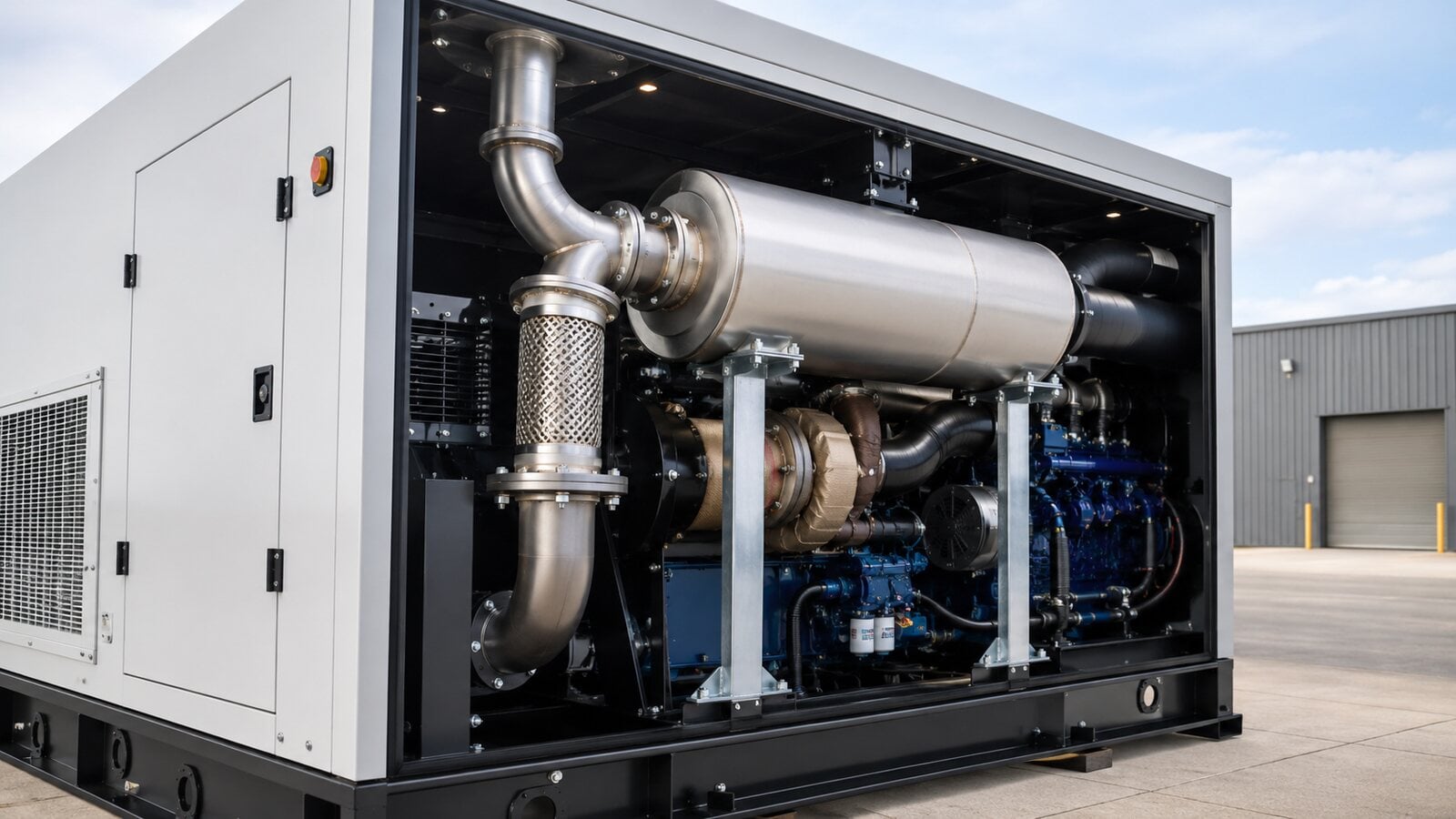
A diesel generator can have the correct engine, alternator, fuel supply, and load capacity yet still struggle because the exhaust system creates too much resistance. Generator exhaust backpressure is the pressure the engine must overcome to push exhaust gas through the flexible connector, silencer, piping, bends, termination, and any aftertreatment equipment.
Every part of that path adds some restriction. If the total exceeds the engine manufacturer’s limit, the generator may lose usable power, run hotter, smoke under load, or place unnecessary stress on the turbocharger and exhaust components. The correct limit, measurement location, and test condition vary by engine model and rating, so installers should never choose pipe size based on a generic rule alone.
What generator exhaust backpressure means
During the exhaust stroke, the engine pushes combustion gas out of the cylinders and through the exhaust system. The turbocharger uses some of that gas energy before the flow continues downstream. Pipe walls, bends, silencers, outlet fittings, and emissions equipment resist flow and create upstream pressure.
A properly designed system keeps the total resistance within the engine manufacturer’s published limit at the applicable operating condition. Manufacturers may specify a maximum pressure at a defined test point and engine load. They may also publish different requirements for different ratings, emissions configurations, or exhaust arrangements. Always use the data for the exact engine and generator configuration.

Where exhaust restriction comes from
Backpressure does not come from a single component. The designer must consider the combined effect of the complete exhaust path.
- Pipe diameter: A pipe that is too small for the required gas flow can create excessive resistance.
- Pipe length: Longer runs add friction and may require a different design than a short factory arrangement.
- Bends and transitions: Each elbow, tight bend, abrupt reducer, and poorly shaped transition changes the flow and adds restriction.
- Silencer selection: Different silencer designs provide different levels of sound reduction and pressure loss. A quieter silencer can impose more restriction, depending on its construction and flow rating.
- Flexible connectors: A correct connector accommodates engine movement and thermal expansion. A damaged, collapsed, misaligned, or undersized connector can restrict flow.
- Weather protection and termination: Rain caps, screens, outlet fittings, and discharge arrangements must allow adequate flow while protecting the system from water and debris.
- Aftertreatment equipment: Catalysts, diesel particulate filters, and other emissions components add model-specific requirements and can change restrictions as operating conditions change.
Cummins includes exhaust backpressure among the project parameters handled by its Power Suite GenCalc tools. Caterpillar also includes an exhaust backpressure calculator in its commercial generator sizing resources. These tools reinforce an important point: exhaust design belongs in the generator application process, not as an improvised field detail after the equipment arrives.
Why excessive backpressure matters
Excessive restriction makes the engine work harder to clear exhaust gas from the cylinders. Depending on the engine, load, and severity, that condition can reduce performance and increase exhaust temperature. It can also affect turbocharger operation and the engine’s ability to respond when a large load starts.
Possible signs include poor load acceptance, reduced power, dark exhaust smoke, unusually high exhaust temperature, turbocharger concerns, or an engine that reaches a limit before the alternator reaches its expected electrical output. These symptoms do not prove that backpressure caused the problem. Restricted air intake, fuel problems, high ambient temperature, altitude, control settings, overload, and maintenance issues can produce similar symptoms.
A technician should diagnose the complete system before replacing parts. Aurora’s guide to generator derating at altitude and high temperature explains how site conditions can reduce available output even when the exhaust system meets its limit.
Silencer choice involves more than noise reduction
A silencer must suit the exhaust flow, temperature, mounting arrangement, sound target, and allowable pressure loss. Selecting the most aggressive sound rating without checking restriction can create a performance problem. Selecting only for low restriction may fail to meet the site’s acoustic goal.
The project team should evaluate noise and exhaust performance together. The generator enclosure, intake and discharge openings, vibration isolation, foundation, exhaust outlet location, and surrounding structures all affect perceived noise. A silencer cannot correct structure-borne vibration or poor enclosure airflow.
For more context, review Aurora’s articles on generator enclosure design and indoor generator installation. Indoor projects require professional design for combustion air, cooling-air heat rejection, exhaust routing, fire safety, and carbon monoxide protection.
Support the exhaust system independently
The engine and turbocharger should not carry the weight of a remote silencer or long pipe run. Independent supports protect the exhaust outlet from loads caused by pipe weight, vibration, misalignment, and thermal growth. The flexible connector accommodates movement, but it does not replace proper support.
The design should also address expansion, condensate management, weather entry, service access, and safe discharge. Exhaust gas contains carbon monoxide and other harmful combustion products. Route and terminate it according to the applicable manufacturer instructions, codes, permits, and site requirements. A qualified designer or installer must determine the correct location and clearances for the specific project.
Do not confuse exhaust restriction with cooling airflow
Exhaust flow and cooling airflow are separate design problems. A generator can meet its exhaust backpressure limit and still overheat because hot radiator discharge recirculates into the intake. It can also have adequate enclosure airflow while an undersized exhaust system restricts the engine.
Check both systems independently. Confirm combustion and cooling-air requirements, radiator discharge routing, ambient capability, and enclosure pressure along with the exhaust calculation. Aurora’s generator cooldown guide explains why operators should also follow the engine manufacturer’s shutdown guidance after sustained loading.
Measure the finished system under a meaningful load
A calculation guides the design, but commissioning measurements confirm the installed result. A qualified technician can measure exhaust pressure at the engine manufacturer’s specified test location while the generator carries the required test load. The technician should use suitable equipment rated for the expected pressure and temperature.
Record the engine model, generator rating, load, ambient conditions, measurement location, measured pressure, and the manufacturer’s applicable maximum. If the reading approaches or exceeds the limit, review the complete path before changing components. Increasing one pipe section may not solve a restriction caused by the silencer, a tight transition, an outlet fitting, or aftertreatment equipment.
A loaded generator exercise or a controlled commissioning test can also reveal temperature, smoke, frequency, voltage, and load-response behaviour that a no-load start will not show. Use the generator and engine manufacturer’s approved test procedure and operating limits.
Pre-installation exhaust checklist
- Confirm the exact engine model, emissions configuration, duty rating, and published maximum backpressure.
- Obtain the approved exhaust outlet data and the required measurement location.
- List every connector, silencer, pipe section, bend, transition, outlet fitting, and aftertreatment component.
- Calculate the combined restriction at the applicable exhaust flow instead of checking each part in isolation.
- Support the silencer and piping independently from the engine and turbocharger.
- Allow for thermal expansion, vibration, condensate, weather, and service access.
- Coordinate exhaust routing with enclosure airflow, nearby openings, property conditions, and carbon monoxide safety.
- Plan a commissioning measurement under a representative approved load.
- Keep the final calculation, drawings, component data, and test results with the generator’s service records.
Plan the exhaust system before the generator arrives
Early planning gives the project team more options for silencer placement, pipe routing, supports, penetrations, drainage, and safe discharge. It also prevents late changes that can increase restriction, noise, cost, or service difficulty.
Aurora Generators can help customers and qualified installers identify the generator data and application information needed for a project. Review our diesel generator solutions or contact Aurora Generators before finalizing a custom exhaust arrangement. The installer remains responsible for the site-specific design, code compliance, permits, and commissioning.