
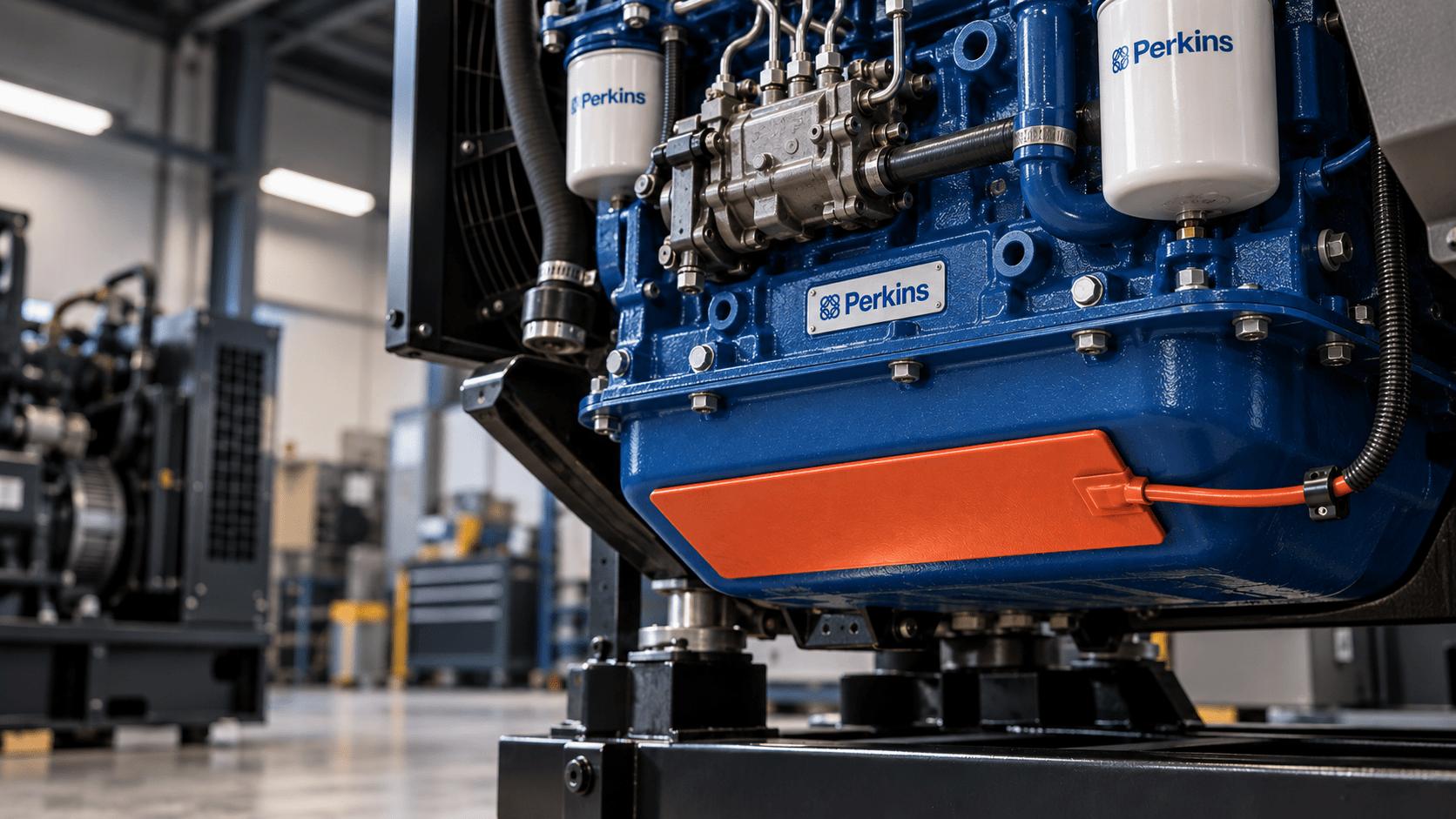
Generator block heaters, jacket-water heaters, and oil pan heaters all improve cold-start readiness, but they warm different parts of a diesel engine. Aurora uses thermostatically controlled silicone-rubber oil pan heaters on many of its smaller enclosed diesel generators. These heaters warm the lubricating oil directly, use relatively little power, and avoid opening the engine cooling system.
An oil pan heater is a highly effective cold-start aid when it is correctly sized and installed. It is not automatically equivalent to a coolant heater in every application, however. The right choice depends on the engine, expected minimum temperature, enclosure, starting battery, required load acceptance, and any manufacturer or installation-standard requirements.
What Is a Generator Oil Pan Heater?
Aurora’s oil pan heaters are flexible silicone-rubber heating pads bonded directly to the outside of the engine’s metal oil pan. They warm the lubricating oil from underneath instead of heating engine coolant through a block-mounted immersion heater or external jacket-water heater.
Strictly speaking, these are silicone pad heaters. Silicon is the raw element widely used in electronics. Silicone is the flexible, heat-resistant material surrounding the electrical heating element.
Inside the pad is a thin electrical resistance element, commonly etched foil or resistance wire. When the heater is energized:
- Electricity heats the resistance element.
- The pad transfers heat directly into the metal oil pan.
- The pan conducts heat into the engine oil.
- Natural convection circulates warmer oil within the sump.
- Heat gradually travels from the pan into the lower engine structure.
Because the pad is bonded directly to the pan, there is very little separation between the heating element and the oil. This puts a modest amount of heat exactly where it helps reduce cold cranking resistance. Phillips & Temro and HOTSTART describe similar direct-contact heaters for oil pans and fluid reservoirs.
How the Thermostat Works
A thermostatically controlled oil pan heater contains a temperature switch in or immediately adjacent to the heating pad. It cycles the heating element on and off according to the temperature at the pad and pan interface.
The thermostat normally senses the pad or oil-pan surface temperature. It does not directly measure average oil temperature or outdoor air temperature. This distinction matters when interpreting the thermostat rating.
For example, Phillips & Temro lists thermostatic silicone-pad models with nominal switching ranges around 170°F to 200°F, or 77°C to 93°C. The oil as a whole normally remains much cooler because heat continuously spreads through the oil, engine structure, and surrounding air. Higher-temperature pad heaters also exist, but some are intended for hydraulic reservoirs or other applications rather than engine oil pans.
Always select the heater for its approved application, oil capacity, surface material, and temperature range. See the manufacturer’s Zerostart silicone-pad heater specifications for an example of application and sizing guidance.
Why Warm Oil Helps a Diesel Generator Start
Cold oil becomes more viscous. The starter must work harder to turn the crankshaft, cranking speed can fall, and the battery experiences a heavier electrical load. Thick oil also takes longer to reach bearings and other lubricated components after the engine starts.
Warming the oil can provide several practical benefits:
- Lower cranking resistance
- Higher cranking speed under the same conditions
- Faster oil circulation and oil-pressure development
- Less battery voltage drop caused by excessive starter load
- Reduced friction during the first moments after starting
This is especially useful on standby generators because the heater can remain connected while the generator waits. The heater draws its full rated power only while heating. Once the thermostat reaches its switching temperature, it cycles the element off until more heat is needed.
Warm oil does not compensate for an undersized, discharged, damaged, or severely cold battery. Oil viscosity, battery capacity, battery charging, cable voltage drop, starter condition, fuel quality, and any glow-plug or intake-heating system must all be suitable for the expected temperature.
Oil Pan Heater Power Consumption
Silicone pad heaters are available in many sizes. Representative ratings for smaller industrial engines include:
- 50 watts for very small oil capacities
- 125 watts for approximately 3 to 6 quarts
- 250 watts for approximately 5 to 13 quarts
- 500 watts for larger sumps
These are general examples, not a universal sizing chart. Oil capacity, usable flat pan area, pan material, ambient temperature, wind exposure, and enclosure heat retention all affect heater selection. Manufacturer sizing guidance takes priority.
A coolant block heater on a small diesel is often rated from approximately 400 to 1,000 watts. A correctly sized 125-watt or 250-watt oil pan heater can therefore have a much lower connected load. The thermostat may reduce actual energy use further.
| Heater rating | Maximum consumption over 24 hours |
|---|---|
| 125 W | 3.0 kWh/day |
| 250 W | 6.0 kWh/day |
| 500 W | 12.0 kWh/day |
These figures assume continuous operation at full rated power. Actual consumption will normally be lower when the thermostat cycles. The duty cycle depends heavily on outdoor temperature, wind, enclosure design, and heat loss from the engine.
Advantages of an Oil Pan Heater
For a suitable smaller diesel generator, an adhesive oil pan heater offers several practical advantages over a coolant immersion heater:
- No coolant needs to be drained.
- No core plug or threaded coolant-jacket plug needs to be removed.
- No new potential coolant leak is introduced at a heater connection.
- It avoids corrosion and sealing concerns around an immersion element.
- It uses relatively little electrical power.
- It directly reduces the viscosity of cold engine oil.
- It does not modify the engine cooling circuit.
- Replacement is generally straightforward when the pan surface remains suitable.
Avoiding removal of an engine plug can be particularly valuable. Some plugs are difficult to access, and a replacement immersion heater must have the correct dimensions, sealing method, watt density, and element orientation. An incorrectly fitted element can leak, contact an internal surface, overheat locally, or fail prematurely.
Oil Pan Heater Versus Coolant Heater
An oil pan heater and a coolant heater do not produce the same temperature distribution inside an engine.
An oil pan heater primarily warms:
- The engine oil
- The oil pan
- The lower crankcase
- Nearby internal components through conduction
Some heat eventually reaches the rest of the engine, particularly inside an enclosed generator. The cylinder head, combustion area, and coolant can nevertheless remain considerably colder than they would with a coolant heater.
A coolant heater warms the cylinder block, coolant passages, and, to some extent, the cylinder head and combustion area. This can improve combustion conditions at start-up, reduce persistent white smoke, and shorten the time required for the engine to stabilize.
A coolant heater may be preferable or required when:
- The generator must start at extremely low temperatures.
- The engine must accept a large load immediately after starting.
- The engine or generator manufacturer specifies a minimum coolant temperature.
- The governing installation standard or project specification requires coolant heating.
- The engine is too large for oil-pan heat to meaningfully warm the upper structure.
- The generator is highly ventilated, uninsulated, or exposed to strong wind.
For severe climates, critical facilities, remote sites, or installations with a high first-load step, the generator manufacturer or a qualified generator specialist should review the complete cold-start package.
Block Heater, Thermosiphon Heater, and Pumped Jacket-Water Heater
People often call every engine preheater a block heater, but coolant-heating systems use several designs.
An immersion block heater places a heating element in direct contact with coolant through an approved engine port. Fitment, watt density, sealing, and element orientation are engine-specific.
An external thermosiphon heater relies on natural circulation. Heated coolant rises toward the engine while cooler coolant returns to the heater. Mounting height, hose routing, flow direction, restrictions, air pockets, and valve position determine whether it circulates properly.
A pumped jacket-water heater uses a circulation pump to distribute warmed coolant. It can provide more uniform heating on larger engines or where natural circulation is unsuitable, but it adds a pump, controls, hoses, fittings, and installation requirements.
These systems cannot be selected by wattage alone. Heater type, supply voltage, thermostat range, engine compatibility, plumbing, and control requirements must match the approved package.
Oil Pan Heater Installation Is Critical
Silicone pad heaters depend on full contact with a suitable metal surface. Air gaps or poorly adhered areas act as insulation, creating localized hot spots that can damage the heater.
A proper installation generally requires:
- A smooth, flat area on a steel or aluminum oil pan
- Removal of paint, oil, grease, rust, and loose material as instructed
- A completely clean and dry bonding surface
- Full adhesion without bubbles, wrinkles, or air pockets
- Clearance from ribs, seams, drain plugs, sharp bends, and embossed areas
- Perimeter sealing with the specified high-temperature silicone
- Cord support and protection from vibration, exhaust heat, moving parts, and sharp edges
Do not install a pad heater on a plastic or composite oil pan unless the heater manufacturer specifically approves that application. Phillips & Temro warns that poor surface contact can create hot spots and heater failure in its Zerostart heater guidance.
Once bonded, the pad should be considered permanent. Removal normally damages the adhesive or heating element, so a used pad should not be repositioned and reused.
How to Check an Oil Pan Heater
A warm spot on the pad does not by itself prove that the heater is correctly sized or transferring heat evenly. After the system has had time to stabilize, verify that the pan warms across the bonded area and that no edges are unusually hot or any sections are cold.
Inspect for lifting corners, bubbles, damaged wiring, hardened sealant, oil contamination, abrasion, and cord contact with hot or moving parts. Qualified personnel can confirm supply voltage and current draw against the heater rating. Repeated breaker or ground-fault trips require diagnosis, not repeated resetting.
When evaluating cold-start performance, observe cranking speed, crank time, oil-pressure response, smoke, time to stable speed, voltage and frequency recovery, and any controller alarms. A successful unloaded exercise does not prove that the generator can accept its required winter load.
Pre-Winter Generator Heater Checklist
- Identify the exact generator, engine, oil capacity, and installed heater.
- Confirm that the heater is approved for an engine oil pan and correctly sized for the application.
- Inspect pad adhesion, perimeter sealant, wiring, strain relief, receptacle, and protective devices.
- Confirm the pad is attached to suitable metal with no lifted areas or visible air pockets.
- Use the engine manufacturer’s approved oil viscosity for the expected temperature.
- Test the starting battery and cables under load, not only by measuring resting voltage.
- Allow the heater to stabilize and confirm that heat transfers into the pan rather than remaining concentrated in one spot.
- For coolant heaters, also inspect coolant level, condition, hoses, clamps, valves, mounting, and circulation.
- Perform an approved cold-start or readiness test under controlled conditions.
- Correct slow cranking, electrical trips, leaks, poor adhesion, uneven heating, or alarms before severe weather arrives.
Aurora’s generator starting-battery test guide explains why acceptable resting voltage does not prove cranking capability. If the generator uses a coolant heater, see our guide to diesel generator coolant testing as well.
Choosing the Right Generator Heater
For many smaller enclosed Aurora diesel generators, a correctly sized thermostatic oil pan heater is a sensible alternative to a conventional coolant block heater. It uses less power, avoids opening the cooling system, reduces cranking effort, and helps lubricating oil reach critical components sooner.
It should still be described accurately. An oil pan heater is an effective low-power cold-start aid, but it does not warm the cylinder head and coolant as directly as a block heater or jacket-water heater. The best solution depends on the engine, expected minimum temperature, enclosure, battery system, load sequence, and applicable requirements.
Contact Aurora Generators with the generator model, expected minimum temperature, and load requirements. We can help determine whether an oil pan heater, coolant heater, or more complete cold-weather package is appropriate.
Share this:
- Print (Opens in new window) Print
- Email a link to a friend (Opens in new window) Email
- Share on Facebook (Opens in new window) Facebook
- Share on LinkedIn (Opens in new window) LinkedIn
- Share on Reddit (Opens in new window) Reddit
- Share on Pinterest (Opens in new window) Pinterest
- Share on Threads (Opens in new window) Threads
- Share on X (Opens in new window) X
- Share on Bluesky (Opens in new window) Bluesky