
Coolant does more than keep a diesel generator from freezing. It carries heat away from the engine, helps control corrosion, protects wet cylinder liners where applicable, and supports dependable operation during a long outage. A full reservoir and bright coolant colour do not prove that the fluid can still do those jobs.
Diesel generator coolant testing should answer several separate questions: Is the coolant the correct type? Does it provide suitable freeze protection? Are its inhibitors still within the range required for that chemistry? Is contamination developing? Can the complete cooling system reject heat under load? The engine operation and maintenance manual, coolant manufacturer instructions, and service records must guide the final decision.
Why coolant colour is not a reliable test
Coolant colour can help identify a leak, but it does not reliably identify chemistry, condition, or compatibility. Different products may share a colour, and similar chemistries may use different colours. Age, contamination, lighting, and previous top-ups can also change how the fluid looks.
Do not add coolant based on colour alone. Mixing conventional heavy-duty coolant with an extended-life formulation can reduce the intended protection or make future testing difficult to interpret. If you don’t know what’s installed, review the service records and the generator or engine manual before adding an inhibitor, extender, concentrate, premix, or plain water.
Start by identifying the required coolant
The correct specification depends on the engine, cooling-system materials, operating environment, and manufacturer requirements. Some systems use conventional heavy-duty coolant that requires periodic inhibitor or supplemental coolant additive testing. Other systems use extended-life coolant with an additive package that follows a different maintenance plan.
That distinction matters. Perkins coolant guidance notes that its heavy-duty coolant requires additive testing, while its extended-life coolant does not use the same inhibitor-testing routine. Caterpillar coolant guidance likewise lists conventional and extended-life coolant families with different additive requirements. These examples show why a universal test strip or a routine dose of SCA is not appropriate for every generator.
Before testing, record the engine model, coolant specification, product name if known, last fill or replacement date, previous test results, and any recent top-ups. Also confirm whether the container holds premixed coolant or concentrate. A premix is ready for use as supplied, while a concentrate requires the water quality and mixing ratio specified by its manufacturer.
Five checks that build a useful coolant assessment
1. Check level and look for leaks when the engine is cool
Follow the generator and engine instructions before opening any cooling-system cap. Hot coolant can remain pressurized and cause severe burns. With the engine safely shut down and cool, inspect the reservoir level, radiator, cap, hoses, clamps, water-pump area, coolant heater connections, and the ground beneath the set.
A low level is a symptom, not a complete diagnosis. Repeated top-ups can dilute the coolant, hide a leak, introduce incompatible chemistry, or leave air in the system. Find and correct the cause, then restore the system with the approved fluid and procedure.
2. Measure freeze protection with the correct instrument
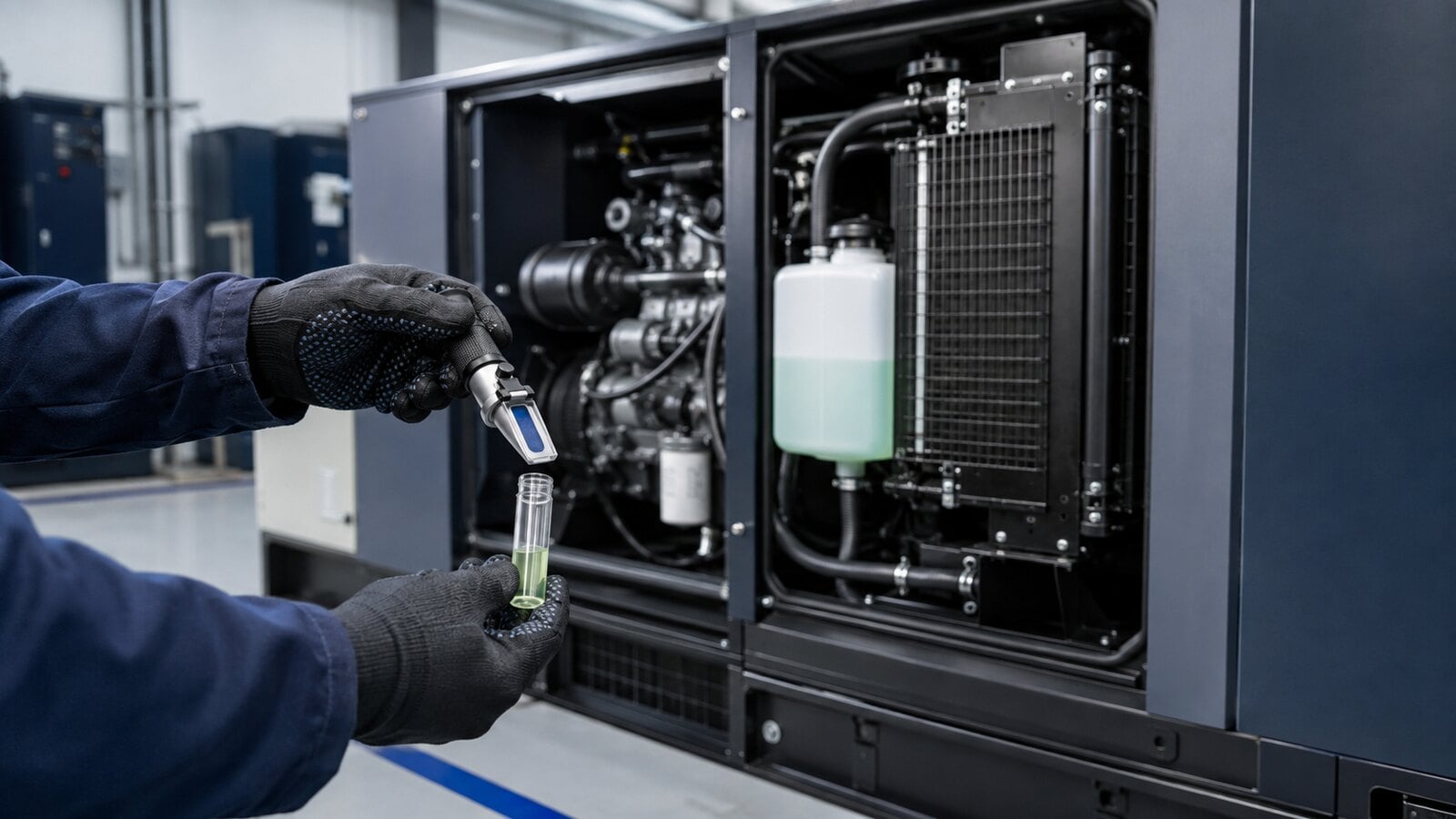
A refractometer or coolant-specific hydrometer can estimate glycol concentration and freeze protection. Use an instrument and scale intended for the actual coolant base, calibrate it as instructed, and take a representative sample. A tool intended for one fluid can give a misleading result when used with another.
Freeze-point measurement does not prove that corrosion inhibitors remain healthy. It also does not confirm that the coolant is clean or compatible with the engine. Treat it as one result within the full assessment.
3. Test inhibitors or SCA only when the coolant requires it
Conventional heavy-duty coolant may require test strips or another approved method to assess inhibitor concentration. Use the strip specified for that coolant, check its expiry date, follow the timing instructions, and compare the result with the engine and coolant manufacturer limits.
Do not add SCA as a precaution to every cooling system. Some extended-life formulations do not require routine SCA additions, and an incorrect additive or excessive dose can create deposits, reduce heat transfer, or upset the intended chemistry. If a product requires an extender at a specified service point, use that product and interval rather than substituting a generic additive.
4. Use pH and laboratory analysis appropriately
Coolant pH can provide useful evidence of chemical change, but an acceptable range is product-specific. A single pH reading cannot identify every form of contamination or determine whether mixed coolant remains suitable. Compare the result with the correct specification and, when possible, with previous samples.
Laboratory analysis can help when coolant history is uncertain, contamination is suspected, or a large system makes an unnecessary drain costly. Depending on the service, analysis may report glycol concentration, freeze point, pH, inhibitor condition, conductivity, corrosion metals, and contamination. Ask the laboratory whether its interpretation matches the installed coolant chemistry.
5. Inspect the hardware that moves and rejects heat
Good coolant cannot compensate for blocked radiator fins, damaged hoses, a weak cap, a slipping belt, restricted airflow, a failed thermostat, a deteriorating water pump, or an enclosure airflow problem. Inspect these items according to the generator maintenance plan.
Confirm cooling performance during a controlled loaded test when the manufacturer and site procedure call for it. Watch coolant temperature, alarms, fan operation, leaks, and temperature stability. A no-load exercise may not create enough heat to reveal a marginal radiator or airflow problem. Aurora’s guide to generator overheating prevention explains the wider heat-rejection checks that support this assessment.
What common results may mean
- Correct specification, stable freeze protection, acceptable condition, and no leaks: Record the results and follow the manufacturer’s maintenance plan.
- Low coolant level: Investigate the leak or loss before repeated topping up. Restore the level with the approved product and bleeding procedure.
- Freeze protection outside the required range: Confirm the test method and coolant identity, then correct the mixture per the manufacturer’s instructions. More concentrate is not always better.
- Conventional coolant with depleted inhibitor: Add only the approved product and amount after a valid test. Retest as directed.
- Extended-life coolant with uncertain history: Do not assume that a conventional SCA will fix it. Verify the product, test method, and replacement or extender requirement.
- Oil, fuel, rust, scale, sludge, or recurring discolouration: Investigate the source. Fluid replacement alone may not correct an internal leak or cooling-system fault.
- Mixed or unknown chemistry: Obtain a qualified assessment. A controlled drain, cleaning procedure, and refill may be safer than guessing, but the exact process must follow the engine and coolant instructions.
Prepare the cooling system before cold weather
Late summer and early fall provide time to correct coolant problems before Canadian temperatures fall. Record the measured freeze protection rather than assuming a previous mixture remains unchanged. Inspect the reservoir, cap, hoses, clamps, radiator, coolant heater, and any signs of seepage. Confirm that the installed coolant remains within its manufacturer-specific time and operating-hour limits.
A block heater supports cold starting and can reduce warm-up time, but it does not replace correct coolant chemistry or adequate freeze protection. The heater also depends on proper coolant level and circulation. Review generator cold-weather starting for related battery, fuel, and preheating considerations.
When should coolant be replaced?
Replace coolant when the applicable engine or coolant schedule requires it, when valid testing shows the fluid cannot be corrected within specification, or when contamination and mixed chemistry make continued use uncertain. A repair that opens the cooling system may also create an appropriate service point.
Do not apply one replacement interval to every diesel generator. Manufacturer limits differ by engine family, coolant product, duty, and service conditions. Flushing agents, water quality, refill methods, venting, and disposal requirements also vary. Follow the operation and maintenance manual and local environmental rules.
Practical coolant-testing checklist
- Identify the engine and required coolant specification.
- Confirm the installed product, premix or concentrate status, age, and service history.
- Shut down the generator, prevent automatic starting, and allow the system to cool.
- Inspect the level, cap, reservoir, radiator, hoses, clamps, heater connections, and leaks.
- Measure freeze protection with a compatible, calibrated tool.
- Test inhibitors, SCA, pH, or other properties only with methods approved for that coolant.
- Investigate contamination, recurring loss, or uncertain chemistry before adding products.
- Verify cooling performance under an appropriate controlled load when required.
- Record the results, corrective work, product used, and next service point.
For a broader maintenance review, see Aurora’s diesel generator maintenance guide and current diesel generator options.
Plan coolant service with Aurora Generators
Aurora Generators can help owners review generator application, maintenance history, and the information needed to identify the correct engine-specific coolant procedure. Contact Aurora Generators before winter or before a planned extended run. Keep the engine model, serial information, coolant product, and recent test results available so the recommendation can match the equipment.
Share this:
- Print (Opens in new window) Print
- Email a link to a friend (Opens in new window) Email
- Share on Facebook (Opens in new window) Facebook
- Share on LinkedIn (Opens in new window) LinkedIn
- Share on Reddit (Opens in new window) Reddit
- Share on Pinterest (Opens in new window) Pinterest
- Share on Threads (Opens in new window) Threads
- Share on X (Opens in new window) X
- Share on Bluesky (Opens in new window) Bluesky