
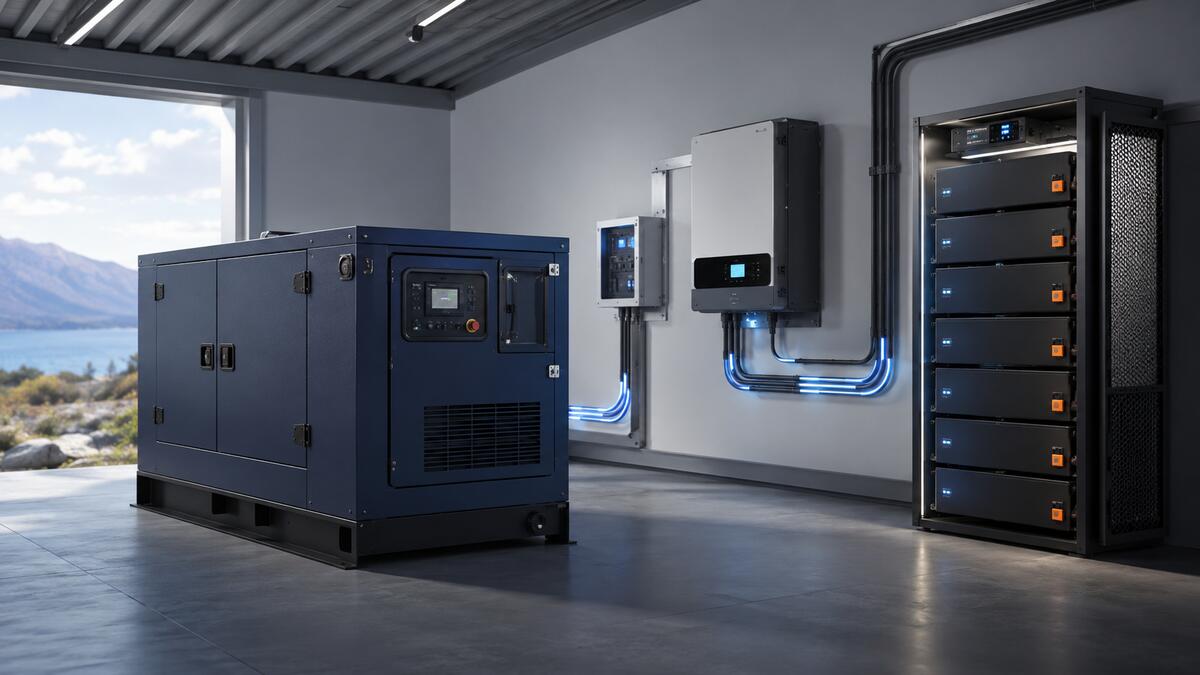
Generator Overload When Charging Batteries: What Is Actually Happening?
A defective generator rarely causes a generator overload when charging batteries. More often, the system demands more real power or apparent power than the generator can supply. The battery charger may be set too high, other loads may run at the same time, or someone may select the generator from the wrong number on the nameplate.
This is common in off-grid solar systems, cottages, telecom sites, and battery-backed buildings. An inverter-charger can draw a large, sustained AC load while it is bulk-charging a battery bank. Add a well pump, compressor, HVAC equipment, water heater, or shop load, and the generator can bog down, trip its breaker, show a fault, or produce low voltage and frequency.
The solution is not automatically to buy the largest generator available. First, confirm what the charger is actually asking for, what else operates while charging, and whether the generator is sized for both normal running and short-duration surges.
The Three Numbers You Must Know
Before changing settings or generator size, identify these three values:
1. Maximum charger input power
This is the AC power the inverter-charger draws while charging. Do not confuse battery-side charging amps with generator-side AC input. A 48 V charger delivering 100 A to batteries supplies about 4.8 kW on the DC side before losses. Its AC input demand will be higher once conversion losses and the charger’s power factor are considered.
2. Loads that run while charging
The generator must support the charger and every load that can run at the same time. Continuous loads such as refrigeration, lighting, pumps, ventilation, and communications equipment count. So do occasional loads such as a well pump or air compressor if they can start while the charger is at full output.
3. The generator’s applicable rating
Check whether the published number represents standby, prime, or continuous-duty power. These ratings are not interchangeable. The engine, alternator, ambient temperature, altitude, voltage, and power factor can all affect usable capacity. Always use the manufacturer’s data for the specific generator configuration.
Why kW Alone Does Not Tell the Whole Story
Generators are limited by both kW and kVA. kW is the real power doing useful work. kVA is the total electrical capacity the alternator must deliver. The relationship is:
kVA = kW ÷ power factor
Many modern inverter-chargers have power-factor correction and operate close to unity power factor under normal conditions. Others do not. A charger with a lower power factor can require more kVA from the generator than its kW reading suggests.
Non-linear charging loads can also create waveform distortion and high crest-factor demand. That can make a marginal alternator struggle even if the average watt reading appears acceptable. This is one reason two generators with the same advertised kW rating may behave differently with the same inverter-charger.
Check the inverter-charger manual for:
- Maximum AC input current
- Maximum AC charging current or charging power
- Input power factor
- Inrush or transfer requirements
- Recommended generator size
- Any generator-support, power-assist, or input-current-limit setting
Aurora’s Practical Diesel-Generator Loading Target
For a diesel generator that will charge batteries regularly, Aurora generally aims for roughly 70% of the applicable running rating during the normal charging period. In practice, a steady operating range of about 60% to 80% is often a strong target for a properly matched diesel generator.
That gives the engine a productive load, supports good combustion and fuel efficiency, and leaves reasonable room for normal load changes. It also helps avoid a common off-grid mistake: selecting a large AC generator for occasional peak demand, then operating it lightly loaded for hours while an inverter-charger tapers.
In a well-designed hybrid system, the generator starts when the battery bank or site load requires support, carries a productive charging load, and then shuts down so solar and stored energy can resume the lead role. Aurora explains that operating strategy in Integrating Solar with a DC Generator.
This is a design target, not a universal rule or a replacement for the engine manufacturer’s rating. Fuel-consumption curves, emissions equipment, cooling capacity, alternator capability, and duty rating differ by model. Do not assume a generator can operate continuously at 100% of its advertised output simply because the nameplate shows that number. Avoid designing a system to run flat-out continuously unless the specific prime or continuous rating, site conditions, and load profile have been verified.
A Simple Sizing Example
Assume an off-grid property has:
- Inverter-charger AC input while bulk charging: 5.5 kW
- Continuous site loads while charging: 2.0 kW
- Expected normal running demand: 7.5 kW
To target approximately 70% normal loading:
Required generator running capacity = 7.5 kW ÷ 0.70 = 10.7 kW
On this simplified example, a properly configured generator in the 12 kW range may be a reasonable starting point. It still must be checked against the charger’s input current, the generator’s kVA and power-factor rating, motor-starting loads, voltage, altitude, temperature, and the manufacturer’s duty rating.
If a 2 kW well pump starts while the system is charging, the short-duration demand may be much higher than 7.5 kW. The pump’s starting method and locked-rotor or inrush characteristics matter. Do not treat the 70% calculation as the only sizing step.
Four Common Reasons Generators Overload While Charging Batteries
1. The inverter-charger limit is set too high
Many inverter-chargers allow the installer or owner to set maximum AC input current and maximum battery-charging current. If you set the charger above what the generator can support, it may consume nearly all available capacity before other loads are considered.
What to do: Reduce the charger’s AC-input or charge-current limit temporarily, then observe generator voltage, frequency, load percentage, and battery charge rate. Change settings only within the inverter and battery manufacturer’s limits.
2. Sizing only for battery charging
The battery bank does not determine generator size by itself. The inverter-charger capacity and the site’s simultaneous AC loads matter just as much. A generator that can charge batteries well may still overload when a pump, refrigerator, pressure system, or electric heater starts.
What to do: Build a load list that separates continuous loads from motor-starting and discretionary loads. Where practical, schedule heavy loads outside the generator charging window.
3. The generator is operating too close to its limit
Operating near full output leaves little room for voltage dips, heat, altitude derating, dirty filters, motor starts, or charger transients. It can cause nuisance shutdowns and makes the entire system less resilient.
What to do: Select a generator that carries normal charging demand at a productive operating load, then verify that it can handle the highest expected combined load and starting event.
4. The alternator and charger are a poor match
An AC generator feeding an inverter-charger must handle the charger’s input characteristics. Poor power factor, harmonics, or high crest factor can create a problem that is not obvious from the charger’s DC output rating.
What to do: Confirm the charger manufacturer’s generator recommendation. For battery-only charging, consider whether a purpose-built direct DC generator would eliminate the AC-to-DC conversion stage and simplify the system.
A Safe Diagnostic Process
Use this sequence before assuming the generator is faulty:
- Record generator voltage, frequency, kW or amps, and battery charge rate with the charger off.
- Start charging at a reduced charge-current or AC-input limit.
- Increase the setting gradually while monitoring voltage and frequency stability.
- Add normal site loads one at a time, including likely motor loads where safe.
- Compare the measured results with the generator, inverter-charger, and battery specifications.
- If the system becomes unstable, stop increasing load. Have a qualified electrician or off-grid system designer review the installation and settings.
Never bypass a generator breaker, change protective settings to stop nuisance trips, or defeat battery-management-system protections. Those protections are there to prevent equipment damage and fire risk.
When a Direct DC Generator Makes More Sense
An AC generator plus inverter-charger is useful when you need to operate household or site AC loads while charging batteries. It is flexible, but it requires the generator, inverter-charger, and battery system to work together correctly.
If the primary purpose is charging a 24 V or 48 V battery bank, a direct DC generator can be a better fit. A DC generator delivers regulated charging power directly to the battery bus, without a separate AC-to-DC charger stage. That can reduce conversion losses, lower component count, and make it easier to keep the diesel engine in an efficient loading range.
Aurora builds 24 V and 48 V DC generators for off-grid, telecom, hybrid, and remote-power applications. The correct choice depends on whether the system needs AC power, direct DC charging, or both. For a closer technical comparison, see Why Use a DC Generator Instead of an AC Generator and Battery Charger?.
The Bottom Line
When a generator overloads while charging batteries, start with the charger settings and the real combined load. Then verify kW, kVA, power factor, starting loads, and the generator’s applicable duty rating.
For regularly used diesel charging generators, Aurora commonly designs around roughly 70% normal operating load, with adequate capacity for expected variations and starting loads. This supports efficient operation without relying on a generator to run at its limit for long periods.
For help matching an AC or DC diesel generator to your inverter, battery bank, and site loads, request a quote from Aurora Generators with your battery voltage, inverter model, charger settings, continuous loads, and the largest motors or equipment that may run during charging.