A power outage usually feels like a minor hassle. Clocks blink back to zero, the Wi-Fi drops, and you start looking for a flashlight. But when Newfoundland and Labrador recently underwent a power emergency that pushed its grid to the edge, it became clear this was not a routine disruption. The situation exposed deeper vulnerabilities and complications within a system that most people notice only when it stops working.
Underneath the surface of this crisis were a series of surprising and powerful stories. They included rare natural events that are not seen for generations, divers working in brutal conditions with little more than hand tools, and a quiet conservation effort in one province that unexpectedly proved a lifeline for another. Together, these instances offered a glimpse into the less visible side of the power system: the complexity, the risk, and the very real human relationships behind a grid most of us think about only when it fails.
A Power Plant Was Shut Down by a Giant, Under-Water “Slushie”
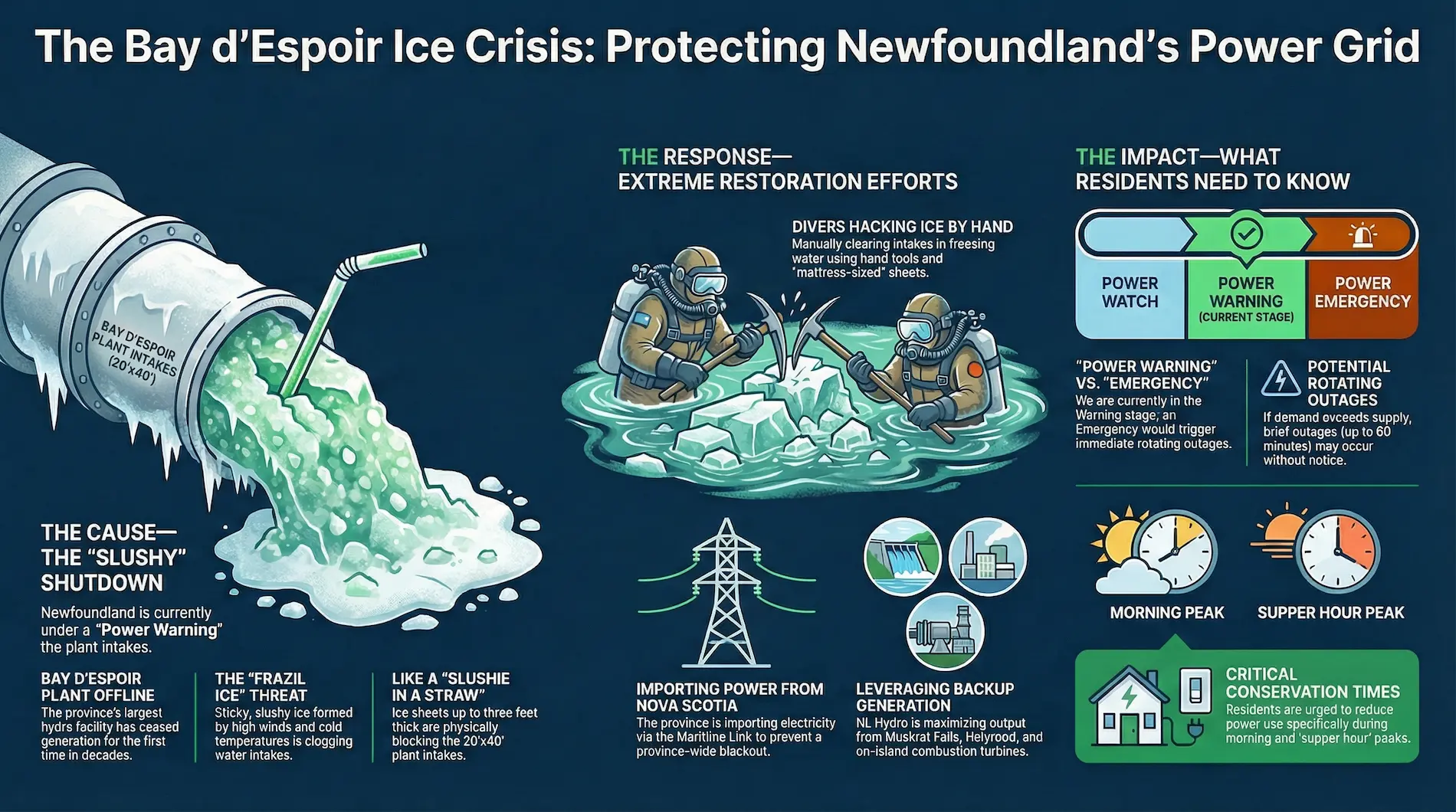
The crisis began when the province’s largest power plant, the Bay d’Espoir hydroelectric station, was effectively taken offline. The culprit wasn’t a mechanical failure or a storm in the traditional sense, but a rare and bizarre natural phenomenon recognized as “frazil ice.”
NL Hydro VP Rob Collett used a remarkably simple analogy to describe the high-tech problem plaguing the massive generating station:
“We are dealing with that ice in the straw… trying to suck a slushie up through a straw.”
Frazil ice consists of small, slushy ice crystals that form in fast-flowing, super-cooled water. These crystals are notorious for sticking to any submerged object, and in this case, they clogged the massive water intakes at Bay d’Espoir, choking off the flow required for power generation. The event was exceptionally rare; it was the first time since 1967 that frazil ice had completely halted electricity generation at the plant.
A Conservation Request in One Province Acted as a Lifeline for Another
As Newfoundland’s grid operators hastened to compensate for the loss of Bay d’Espoir, one of the most touching stories of the crisis quietly unfolded. To prevent widespread blackouts, Newfoundland began importing power from its neighbor, Nova Scotia.
This act of support had a direct impact on Nova Scotians, who were asked to conserve their own power to free up capacity for the import. What might have seemed like a local inconvenience was, in fact, a critical act of cross-provincial solidarity. The gesture was not overlooked. One Reddit user in Newfoundland posted a sincere message of gratitude which captured the feeling of community:
“This may sound sarcastic, but I genuinely mean this. Thank you for your efforts to conserve people. It helps keep Newfoundlands with some heat and lights, and while this may seem selfish, you guys are the real heroes to Newfoundlanders. I mean this a lot…thank you 100%, thank you from the bottom of my heart, thank you.”
In a moment of crisis, the abstract, technical web of the interconnected grid became something tangible and intensely human. A simple request to turn down the thermostat became an essential act of support, disclosing a powerful link that transcends provincial borders.
The High-Tech Problem Required a Low-Tech, High-Risk Solution: Divers with Hand Tools
While grid operators managed the high-tech flow of electrons, the physical problem at Bay d’Espoir required a solution that was nowhere near. The fix was gritty, manual, and dangerous.
To clear the thick slush, the fix was gritty and perilous. Divers had to jump through holes cut into the ice, plunging into the frigid water with hand tools to manually break up a three-foot-thick layer of slush choking the massive 20-by-40-foot intakes. It was a clear contrast: a sophisticated, multi-billion-dollar power system was temporarily dependent on the bodily endurance and courage of individuals working with basic tools in extreme conditions. The recovery effort was a strong reminder of the human element at the heart of our most complex infrastructure.
Keeping the Lights on is a Constant, Billion-Dollar Balancing Act
The frazil ice incident was a dramatic, acute problem, but it also shed light on the chronic, underlying issues of maintaining a power grid in a harsh climate. A separate ice storm in Labrador had recently damaged a portion of the Labrador-Island Link, showing the constant battle against the elements.
This ongoing struggle forces utility companies to make a difficult trade-off between absolute reliability and affordable costs. NL Hydro CEO Jennifer Williams articulated this core dilemma when discussing upgrades to power lines to withstand heavier ice loads:
“It comes down to a ‘cost and reliability balance question.’ Do they invest in upgrading all the two-inch-capacity lines, or deal with issues as they arise? She says they need to be careful not to overinvest because that would impact electricity rates.”
This is the complicated economic reality that is invisible to customers until an outage occurs. Every decision to reinforce the grid against extreme weather must be weighed against its direct impact on every resident’s electricity bill. The frazil ice, unseen since 1967, was the perfect example of a risk that is prohibitively expensive to guard against completely, yet devastating when it occurs.
Counterpoint: The Grid Is Actually More Reliable Than It Used to Be
While a major power warning can make it feel as if the system is failing, a counterintuitive perspective emerged from residents themselves. In a Reddit discussion, many argued that, despite events like this one, power service on the island is significantly more reliable today than it was decades ago.
The public memory of “Dark NL,” a major province-wide blackout in 2014, serves as a measure for how much things have improved. This quiet improvement, they argued, is thanks to years of deliberate, unglamorous work: more preventative maintenance on live lines, an aggressive tree-trimming program to defend against high winds, and a complete upgrade to a stronger pole standard designed to handle the heavy ice loads that are a fact of life on the island. This highlights how public perception during a crisis can occasionally overshadow the long-term, incremental improvements that have strengthened the system.
A power outage is rarely simply a technical problem. As the events in Newfoundland and Labrador showed, it’s a window into the complicated interplay of rare science, gritty engineering, difficult economics, and human community. It reveals the constant balancing act required to keep our modern world running and the extraordinary efforts that unfold when the system is pushed to its limit.
The next time the lights flicker, what hidden accounts of struggle, science, and cooperation might be playing out behind the scenes?