
The house goes silent. The low buzz of the refrigerator, the light of the television, the soft whir of the computer fan, all gone in an instant. Suddenly, you’re plunged into darkness and silence, a clear reminder of how much we rely on a steady flow of electricity. At that moment, many people’s first thought is a backup generator.
But the path to choosing one is often confusing. You’re faced with a wall of technical phrases: running watts, starting watts, surge power. It’s easy to get overwhelmed and either buy a generator that’s far too large for your needs or, worse, one that can’t handle the load when you need it most.
1. The Starting Wattage Trap: Why Most People Miscalculate Their Power Needs
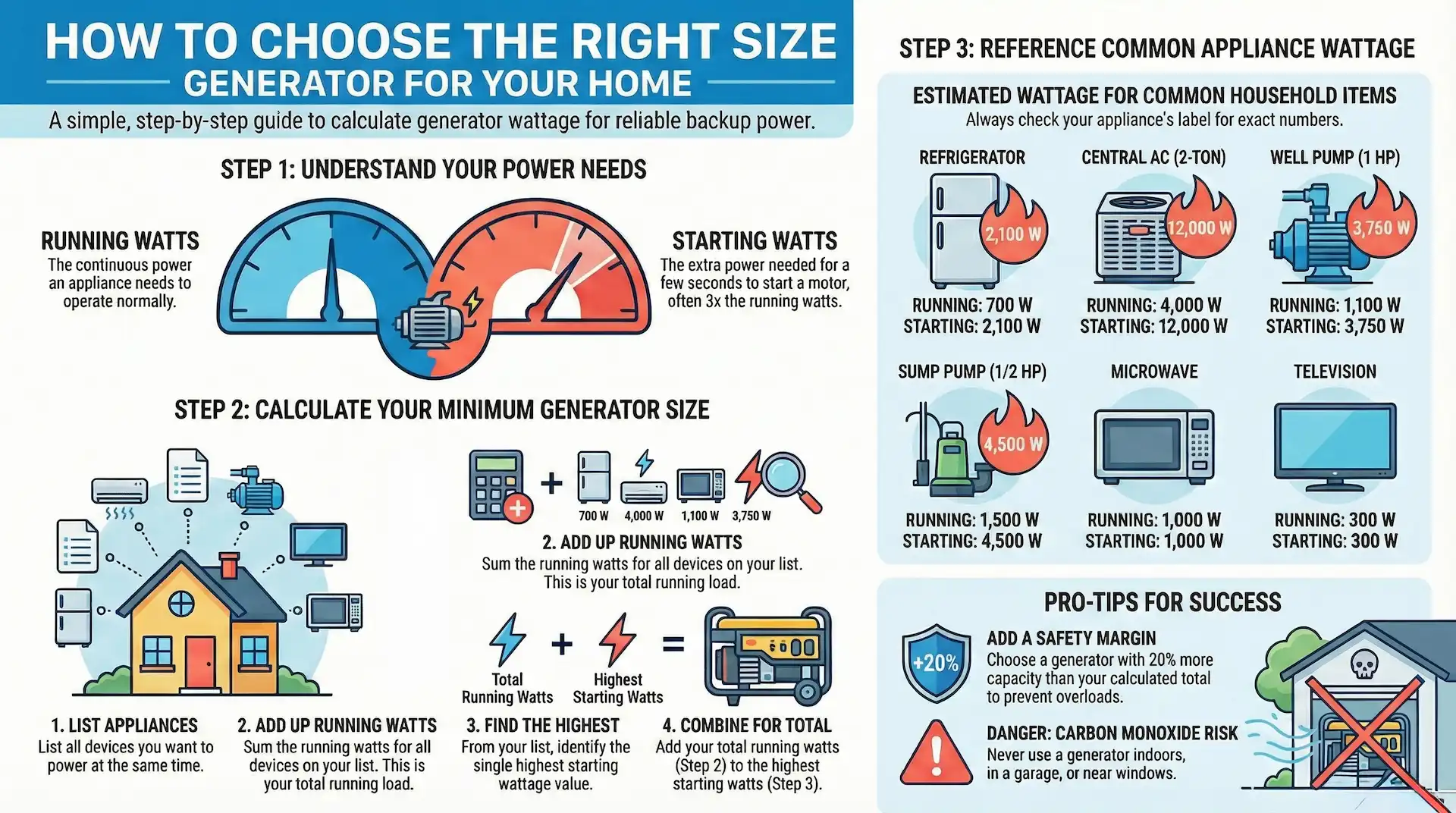
- Running Watts: The continuous power an appliance needs to operate.
- Starting Watts (or Surge Watts): The additional surge of power an appliance with a motor (like a refrigerator or fan) needs for a few seconds during startup.
- The Flawed Method: You might add up all the running watts (500 + 1000 + 40 = 1540W) and then add the starting watts for both motorized items (1200W + 120W = 1320W). This gives you a total of 2860 watts.
- The Correct Method: A more efficient and realistic calculation accounts for the fact that devices get started intermittently.
- First, sum the running watts of all the appliances you plan to power simultaneously (500 + 1000 + 40 = 1540W).
- Next, identify the single appliance with the highest starting wattage (the refrigerator at 1200W).
- Finally, add your total running watts to that single highest starting wattage.
This simple formula gives you the true minimum power your generator needs to provide:
Total Running Watts + Highest Single Starting Watt = Your Minimum Generator Requirement
Using this, our calculation is 1540W + 1200W = 2740 watts.
As you can see, the correct calculation shows a requirement of 2740 watts, while the common mistake could lead you to buy a 4000-watt generator—costing you hundreds of dollars more for capacity you will never use.
2. The "Sensitive Electronics" Myth: What Really Needs Protection
A common fear is that the “dirty” power from a standard portable generator will fry modern electronics like laptops, routers, and flat-screen TVs. This concern leads many to believe they absolutely must buy a more expensive inverter generator.
For most devices, this is largely a myth. Modern electronics, like your computer and laptop, use switching power supplies (think of the power brick on the cord). These components are specifically designed to be robust and handle a wide range of input voltages, making them far less sensitive than people assume.
The quality of power is measured by its Total Harmonic Distortion (THD)—essentially, a score of how “clean” the power is. Utility power from the grid is typically very clean, with THD below 5%. The real “sensitive electronics” in your home are often the control boards in major appliances like high-efficiency furnaces or modern refrigerators, which are built to operate on clean, utility-grade power.
While inverter generators produce the cleanest power (often <3% THD), many high-quality standard generators from reputable brands produce power well within the safe range (<6% THD) for most household electronics. The real danger isn’t the technology type, but the quality of the generator itself.
3. The Invisible Power Drain: How Your Environment Affects Your Generator
- Altitude: As altitude increases, the air becomes less dense. This less-dense air is less effective at transferring heat away from the engine during cooling. Consequently, the generator’s power output must be reduced—or “derated”—to operate within safe temperature limits. As a general rule, you should expect a generator’s power output to decrease by about 3.5% for every 1,000 feet you are above sea level.
- Temperature: In ambient temperatures significantly higher than the standard, a generator’s output also decreases. Increased heat adds operational stress to the engine and electrical components, reducing total efficiency and power capacity.
4. Sizing for a "Whole Home" Is More Than Just Simple Math
- General Lighting and Receptacles: This isn’t just about the bulbs you have on. It’s a standard calculation based on the home’s total square footage (e.g., 3 watts per square foot) to cover all general-use outlets and lighting circuits.
- Dedicated Circuits: The NEC requires dedicated, higher-power circuits for specific areas. A whole-home calculation must include a standard load (e.g., 1500 watts each) for the minimum number of required small appliance circuits in the kitchen and the laundry circuit.
Conclusion: Choosing with Confidence
Share this:
- Print (Opens in new window) Print
- Email a link to a friend (Opens in new window) Email
- Share on Facebook (Opens in new window) Facebook
- Share on LinkedIn (Opens in new window) LinkedIn
- Share on Reddit (Opens in new window) Reddit
- Share on Pinterest (Opens in new window) Pinterest
- Share on Threads (Opens in new window) Threads
- Share on X (Opens in new window) X
- Share on Bluesky (Opens in new window) Bluesky